Part I · Visual Document Retrieval
Chapter 5
ModernVBERT: Towards Smaller Visual Document Retrievers
Introduction
The ability to quickly locate specific information in vast document collections is a core building block of digital systems today, supporting use cases that range from web search and virtual assistants to enterprise knowledge management. Neural information retrieval (IR) models, and in particular dense retrievers, have become the de facto backbone of modern search systems thanks to their strong semantic matching capabilities and good scalability properties .
This trend is amplified by the widespread adoption of Retrieval-Augmented Generation (RAG) , where a retriever is used to select a small set of relevant documents that condition a downstream generator. In such systems, the first-stage retrieval module is a well-known bottleneck: its recall directly upper-bounds the quality of the generated answers, while its latency and indexing costs partially drive the overall system efficiency . As a result, improving document retrieval, especially for long, complex files such as PDFs, scientific articles, and reports, is a key lever for making industrial RAG deployments more accurate and cost-effective.
Visual Document Retrieval. Historically, document retrieval in these settings has operated purely in the text space. To index PDFs or scans, practitioners first run heavy preprocessing pipelines that include Optical Character Recognition (OCR), layout analysis, and heuristic passage segmentation, before embedding the resulting text spans with a neural encoder.
This approach suffers from several limitations: OCR and layout parsing can be brittle and slow, complex visual elements such as tables, figures, and typography are often poorly captured, and any error or bias introduced during preprocessing is propagated to the retriever.
Visual Document Retrieval (VDR) has emerged as a compelling alternative to such text-based systems. Rather than indexing pre-extracted textual content, VDR models directly operate on page screenshots: given a user query, they retrieve relevant document pages by matching the query against image-based representations of the pages . By bypassing OCR and layout parsing, VDR yields simpler end-to-end pipelines, significantly reduces indexing latency, and better exploits visual cues such as layout, figures, and fonts, while achieving strong performance on visually rich benchmarks like ViDoRe.
Limits of Generative VLM Repurposing. Most current VDR systems are obtained by repurposing large generative vision–language decoders as retrieval encoders via post-hoc contrastive fine-tuning . While cost-efficient, this design choice bottlenecks retrieval performance and efficiency: model sizes, attention patterns, image resolutions, and training objectives are designed for generative use cases rather than optimized for retrieval which has been shown in text models to be suboptimal . Furthermore, scaling trends are less pronounced for embedding models; while correlated with model size, strong retrieval performance remains attainable with small models .
Recent papers and model releases in the visual retrieval space have claimed performance improvements by scaling the amount of contrastive data and the compute budget , modifying the attention mask , increasing image resolutions or by introducing more diverse tasks and data sources .
In this work, we attempt to centralize these efforts and systematically disentangle the impact of core design decisions in visual retriever training.
Through controlled experiments—ranging from language model pretraining to multi-stage, domain-specific fine-tuning, we aim to answer a central question:
Which design choices best boost performance in modern visual document retrievers?
Contribution 1. We revisit core assumptions in visual retriever design, showing that token-level training objectives benefit retrievers by strengthening image–text token alignment—rather than merely producing stronger image embeddings. Our results indicate that causal attention is suboptimal in document retrieval, with bidirectional masking offering clear improvements in multi-vector settings, and that other parameters such as image resolution data mixes should not be overlooked in the training pipeline.
Contribution 2: ModernVBERT. Building on these insights, we release ModernVBERT, a small 250M multimodal encoder that aligns a pretrained language encoder with a vision encoder through Masked Language Modeling (MLM) objective, and ColModernVBERT a variant fine-tuned for document retrieval. Despite its modest size and limited training budget, ColModernVBERT matches models 10x larger on standard visual document retrieval benchmarks, demonstrating the interest of designing a retrieval focused model from the ground up.
We release the model, intermediate checkpoints, and the training code at huggingface.co/ModernVBERT.
Methodology
Our analysis aims at quantifying the impact of design decisions made when training visual retrievers. In opposition to previous work, we begin our analysis as early as language model modality alignment and iteratively study design choices by modifying design choices independently to reduce confounding factors as much as possible .
Controlled Experimental Setup. A central point of interest is the impact of causal and bidirectional attention masks. While recently studied for textual representation applications , we extend the experiment to the vision modality. We use checkpoints released by which consist in a series of identical 210M parameter transformer models based on the Llama architecture trained on 100B tokens that differ only in their attention masking strategy during language model training but that are perfectly identical in terms of training data seen, model size and architecture, learning rate scheduling, etc... The checkpoints we use are enc a bidirectional encoder trained with Masked Language Modeling (MLM), dec, a causal decoder trained with next token prediction, and dec-enc a causal decoder annealed over the end of its textual training by removing the causal mask and switching the training objective to MLM. For the vision tower, we employ the vision component of siglip2-base-16b-512 , a 86M parameter vision transformer contrastively trained on billions of text-image pairs. All ablations thus stem from iso-data controlled setups, and as further described, are further trained on the same data sequence, with the same batch sizes, optimizers, schedulers and on the same hardware.
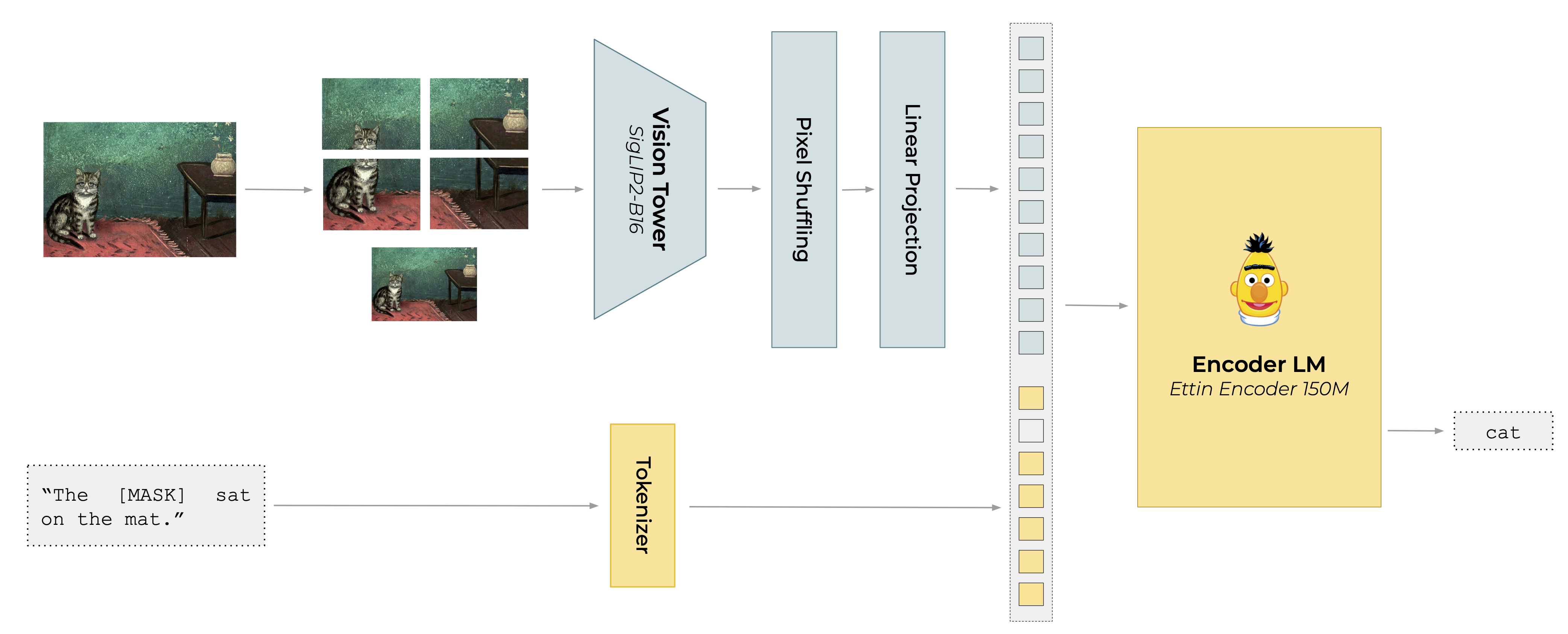
Model Architecture. Our analyses are not centered around model architectures and to draw broadly applicable insights, we design vision-language models following current standard training practices. In line with most recent work, we employ the early fusion architecture illustrated in Figure 2, in which visual patch embeddings produced by the vision encoder are projected into the language model input embedding space and concatenated with text token embeddings to encourage joint processing . As described in Subsection 5.2.1, we generalize the training loss to function both with causal and masked language modeling objectives. To handle dynamic resolutions, we split large images into 512512 pixel tiles as expected by the SigLIP encoder. Following current standard practices, we further process a downscaled version of the full image to improve inter-tile consistency and global visual understanding . The vision tower produces 1024 pixel patch representations for each tile, which we compress to 64 tokens through pixel shuffling with a compression ratio , following prior work on models of comparable size . We highlight the impact of image resolution and this parameter on the number of visual tokens in Appendix E.3.6.1.
Training Procedure. Our experiments focus on retrieval performance. We employ a standard biphasic training procedure, in which we first run modality alignment to train a pretrained textual language model to understand visual inputs through language modeling objectives (Subsection 5.2.1), then rely on a second text-image contrastive learning phase to learn efficient image representations (Subsection 5.2.2). We further describe the general setup, and detail specific modifications to the default training procedure in the experiment section.
Modality Alignment
We align the vision encoder tower with the language model by training the image embedding projection layer to map visual features into the language model embedding space. The pretrained language model is also fine-tuned with Low-Rank Adapters (LoRA) , allowing both image and text models to adapt jointly while reducing the risk of monomodal performance collapse .
Alignment Loss. For decoder‑based models, we train with Causal Language Modeling (CLM) loss on the text tokens, as standardly done in VLM modality alignment:
where denotes all tokens preceding position . We generalize this training scheme to bidirectional encoders models, by using the Masked Language Modeling (MLM) loss on the textual tokens:
where is the set of masked token positions and is the input with those tokens masked out.
Modality Alignment Corpus. Models are modality aligned on a large corpus in large parts derived from The Cauldron 2 and Docmatix . Our objective being to train document focused retrieval models, we use an adjusted training mixture that upsamples images containing text and documents with varying level of complexities. Our final training corpus consists of approximately 2B text tokens, and includes diverse sources such as web pages, books, and scientific papers. Mixture details are given in Appendix E.1.3.1. We note that controlling the exact data distribution during this phase enables the models we train to specialize early and achieve good document focused downstream performances which many large models struggle with .
Parameters. All models are trained using a masking ratio of 0.5 and user-prompt masking to avoid overfitting on chat-template format . We employ WSD scheduler with the first 5% of the training as warmup, the last 20% as decay and a maximum learning rate of 1e-4. The ablation models are aligned on 3.5B tokens. We provide additional details on the training setup in Appendix E.1.1.
Contrastive Post-Training
Once the language model has learned to process image tokens jointly with text tokens, we specialize models through a contrastive post-training stage designed to enhance the semantic representation of the output embeddings produced by the model .
Post-training Pairs. The post-training dataset used as starting point in our ablations comprises 118k document-query pairs from the ColPali corpus (Faysse et al. 2025) as well as another 118k of natural image-description pairs from the MSCOCO train set .
Contrastive Loss. We employ the InfoNCE loss , defined as
where denotes the positive target for the query , the set of negative targets (in-batch and hard negatives when mentioned), and a similarity function between the token(s) of the query and the documents.. For general-domain post-training we compute the loss symmetrically .
Batches Curation. In contrastive learning, batch diversity critically impacts retrieval entropy. Overly heterogeneous batches lead to trivial retrievals, while curated batches yield richer training signals. We employ task-aware batching , grouping documents by source to ensure a homogeneous batch composition.
Ablation Evaluation Setup
The contrastively trained models are evaluated on retrieval and zero-shot classification tasks across multiple domains. Although the main focus remains document retrieval capabilities, evaluated by aggregating scores from the ViDoRe and ViDoRe v2 benchmarks (nDCG@5), we also assess more generalist image retrieval capabilities by selecting tasks from MIEB . For natural image retrieval, we aggregate MSCOCO retrieval and Flickr30k retrieval (nDCG@10) test sets. Finally, following practices in , we assess both zero-shot and fine-tuning abilities of our models on general classification tasks. Specifically, we measure classification accuracy by fine-tuning a logistic regression head on top of our model's embedding on Stanford Cars and Food101 , and we evaluate zero-shot performance on FER2013 and EuroSAT and aggregate the results.
What Makes a Great Visual Retriever?
Vision-language retrievers built upon existing generative VLMs often inherit design choices and weights that may not be well suited for all embedding tasks. Here, we analyze these critical design choices hoping to derive clear insights for developing efficient visual retrievers. Importantly, although we assess design decisions at different stages of the training pipelines, evaluation are always done end-to-end on the final evaluation signal.
Modality Alignment Design
Language modeling Modality Alignment improves document understanding.
According to benchmarks such as MIEB , dual encoder models explicitly trained on contrastive image-text tasks outperform repurposed VLMs in natural image classification tasks.
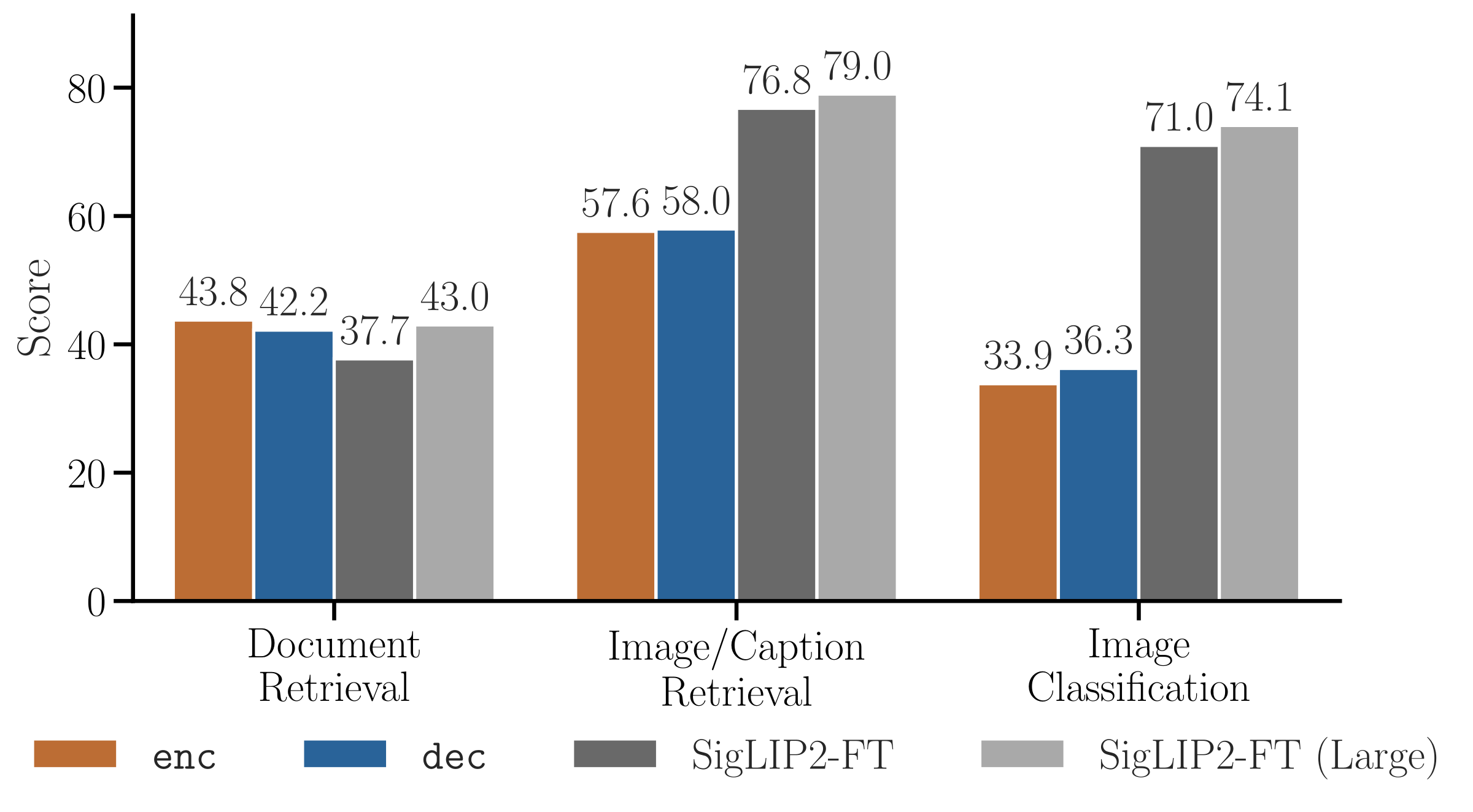
To assess this, we train an encoder and a decoder vision-language model using the methodology described in Section 5.2 on a mix of natural image and document data (alignment and contrastive training). We compare them with SigLIP2-FT, the 378M dual vision encoder model whose vision component is used by the vision tower of both VLMs, and with the larger SigLIP2-FT Large (881M parameters). Both SigLIP-FT models are finetuned in the same conditions as the VLMs, and initialized from pre-trained weights from scratch on billions of text-image pairs. As shown in Figure 3, the two early fusion VLM variants severely underperform the SigLIP2-FT dual encoders on natural image tasks. In contrast, they achieve significant gains on document retrieval tasks (+6.1 nDCG@5 on ViDoRe and ViDoRe v2 datasets w.r.t. base), even edging out SigLIP2-FT Large that contains 3.5x vision parameters more than both VLMs.
This confirms large-scale contrastive training remains best for high-level image representation tasks (natural images), but sequentially combining a vision model with a pretrained language model facilitates document representation tasks, even with significantly less contrastive post-training. As the rest of this paper shows, steering away from the dual encoder architecture further enables improving performance through many avenues other than text to image contrastive training, for which supervised training samples can be hard to obtain.
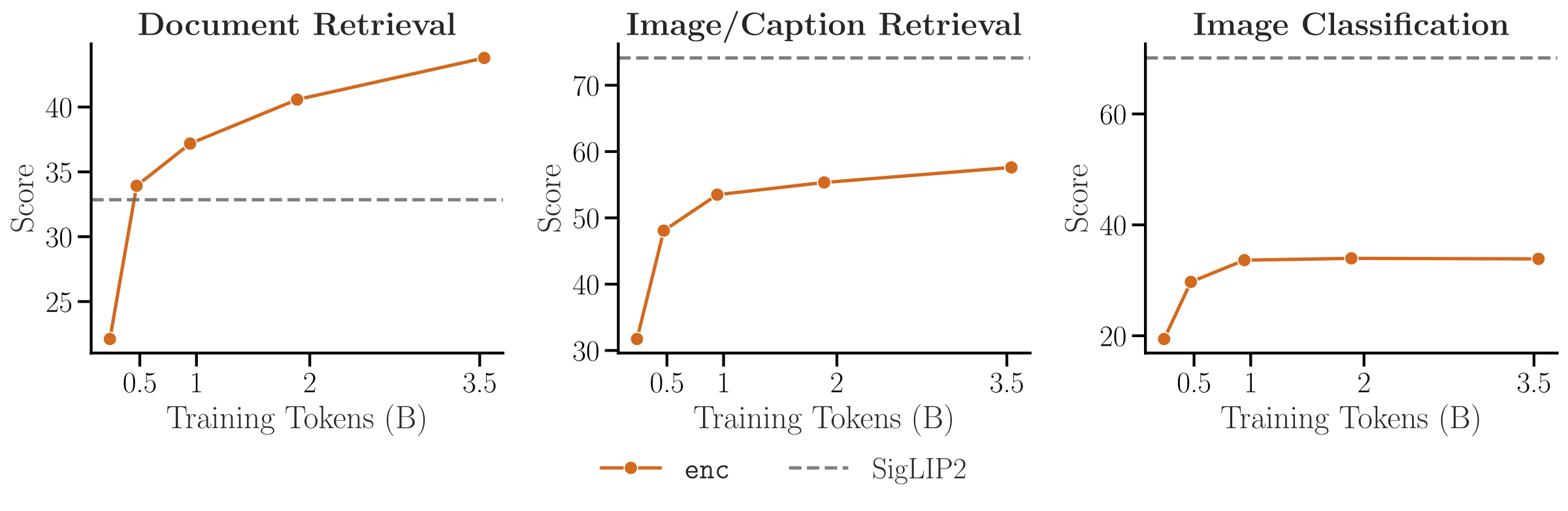
Scaling the modality alignment phase for better token representations. Prior work shows that scaling the modality alignment phase of VLMs improves their generative abilities . We test whether similar gains hold in retrieval by contrastively fine-tuning enc checkpoints during MLM modality alignment. Figure 4 illustrates the results of post-trained checkpoints on diverse tasks. Although document retrieval improves consistently with more modality alignment data – largely surpassing the vision tower evaluated in isolation and showing clear scaling benefits – natural image tasks plateau past 1B tokens, far from the standalone dual encoder baseline. This shows that document and natural image retrieval leverage different mechanisms and should not be optimized the same way. Document Retrieval benefits from learning fine-grained interactions between image and text tokens through the language model, while the LM has limited utility for high level natural image tasks.
Bidirectional attention fully unlocks Late Interaction. Inspired by the effectiveness of bidirectional attention in text-only retrieval , we investigate if it surpasses causal attention in visual document retrieval, particularly when using the multi-vector late interaction matching common in SOTA visual retrievers .
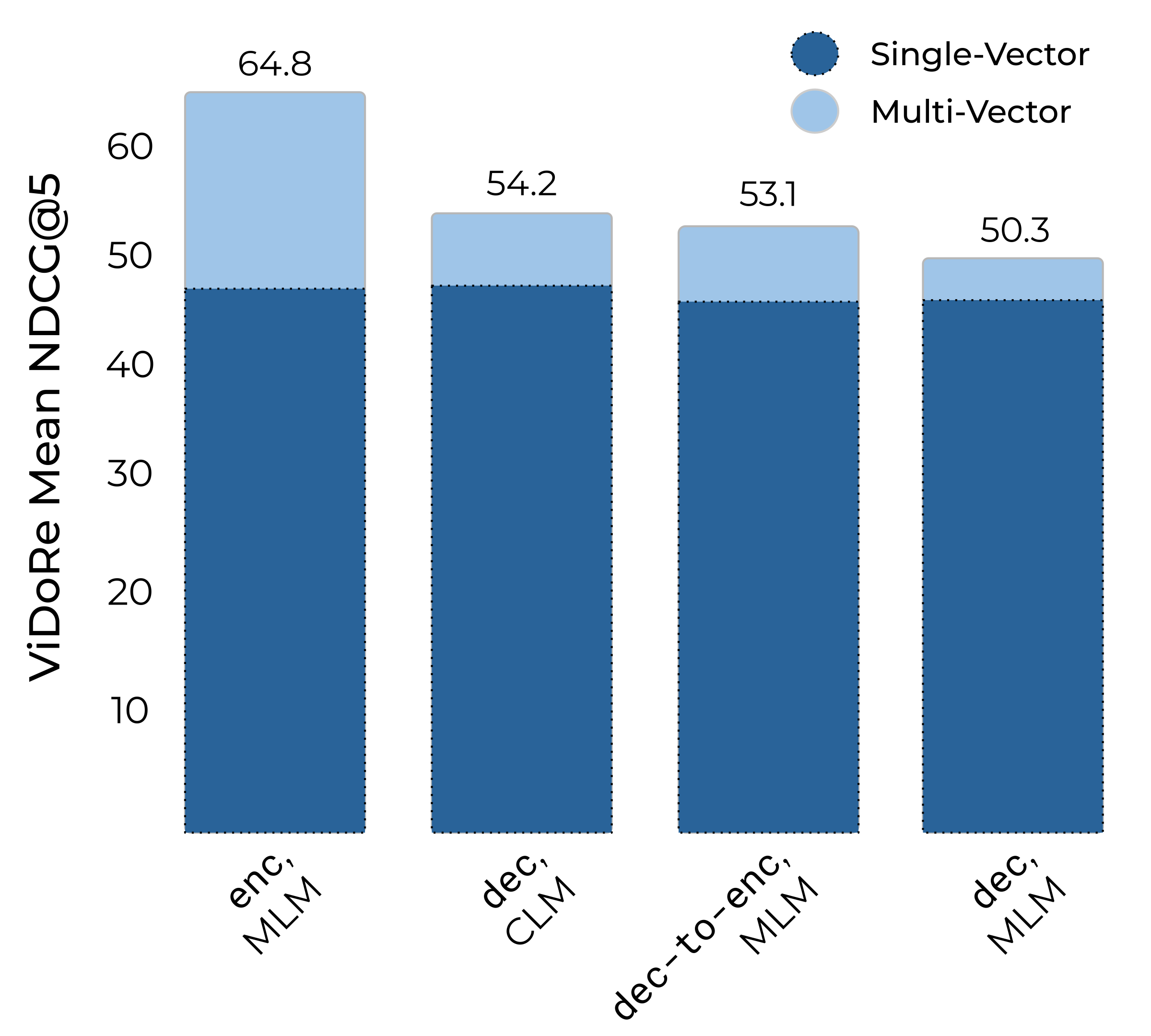
Figure 5 reports single vector and late interaction results on the ViDoRe benchmark for various model variants. On top of the standard enc (MLM) and dec (CLM) models, we evaluate the dec-enc and the dec models modality aligned with MLM objectives to determine whether bidirectional attention capabilities can be obtained in later stages of training.
Single-vector embedding results are close between bidirectional and causal attention models for document retrieval, with enc slightly outperforming dec by +1.6 nDCG@5.
Intuitively however, bidirectional attention makes a huge difference when used in late interaction settings, substantially exceeding the causal counterpart by +10.6 nDCG@5.
Causal decoders are incapable of correctly contextualizing image or text token representations seen at the beginning of the sequences. This is a key result as almost all current visual retrievers, including late interaction variants, are causal models, clearly indicating some performance is left on the table.
Removing the causal attention mask during training does not suffice to recover the enc late interaction performance at these data regimes. This indicates converting trained decoders as late interaction retrievers is highly non trivial, and confirms the insights from ; when possible, training encoder models from scratch remain better for retrieval tasks.
| HR Cooldown | Document Retrieval | Image/Caption Retrieval | Image Classification | Average | |
| 512px | × | 30.7 | 58.8 | 41.4 | 43.6 |
| 1024px | × | 42.2 | 58.9 | 37.2 | 46.1 |
| 2048px | × | 43.8 | 57.6 | 33.9 | 45.1 |
| 2048px | ✓ | 45.8 | 57.8 | 33.7 | 45.8 |
Contrastive Training Design
The previous subsection established bidirectional encoder models to often be the best option when training visual retrievers. In the following experiments, we assess contrastive training choices and only report results for the encoder model for simplicity.
Image resolution benefits are task-specific. Image resolution plays a critical role in VLM generative capabilities, notably in document-focused tasks, as higher-resolution inputs enables the model to capture finer visual cues .
Modality alignment is done at a fixed image resolution of 1024 pixels (longer side) and we report scores of contrastive training runs with varying settings in Table 1. To vary the resolution, images of the highest quality available are scaled to the desired size (often downscaled) before being fed to the image tokenizer. Our findings confirm that embedding tasks are strongly sensitive to image-resolution. In particular, training with higher resolution inputs substantially improves the results on visual document retrieval benchmarks, consistent with prior work in generative settings (Beyer et al. 2024; McKinzie et al. 2024). Furthermore, adding a cool-down phase by showing higher-resolution images towards the end of the modality alignment phase yields additional gains. This suggests that models can adapt their attention mechanisms to finer details when exposed to increased resolution. Interestingly, these findings do not hold in natural image tasks, where high resolution can even degrade performance.
| Document Retrieval | Image/Caption Retrieval | Image Classification | Average | |
| Baseline CL Mix | 43.9 | 57.2 | 36.1 | 45.7 |
| + TextText Pairs | 45.6 | 53.2 | 35.7 | 44.8 |
| + ImageCaption Pairs | 45.8 | 54.4 | 49.9 | 50.0 |
Increasing the pool of contrastive pairs.
A severe limitation that current visual retrievers face is the lack of large volumes of high quality (document image, query pairs). Previous work has relied on a mix of repurposed existing visual question answering datasets and synthetically generated queries with external LLMs. Even put together however, the field is only a year old, and these datasets remain small in size and often of poor quality.
A central question in our study is whether the abundance of text-only query–document pairs can be exploited to improve visual retrieval via cross-modal capability transfer. To probe this, we run contrastive training under three regimes. Unlike prior work that “warms up” visual retrievers or trains exclusively with text-only pairs , we interleave text-only pairs and text–image pairs throughout training at a 1:1 ratio. The dataset sources are detailed in Appendix E.1.3.3
As reported in Table 2, incorporating text-only pairs yields a sizeable improvement on visual document retrieval (+1.7 nDCG@5), indicating clear cross-modal transfer—likely facilitated by the backbone’s jointly learned text–image embedding space. This result suggests that domain-specific training corpora can be assembled irrespective of native modality, reducing duplication of effort and lowering data-collection costs.
We further evaluate training with NatCap, a corpus of natural images paired with synthetic, highly detailed captions (see Appendix E.1.3.2). This scaling step improves downstream performance across the board—most notably on natural-image tasks, and with a smaller but consistent gain on document retrieval (+0.2 nDCG@5). Together, these findings underscore the importance of scaling contrastive learning with high-quality data, but which doesn't need to be exclusively image document focused.
Building a Small yet Mighty Visual Retriever.
Training.
Recipe. Putting together the results from our experiments, we devise a training recipe for a small visual document retriever ModernVBERT. It combines a state-of-the-art 150M text bidirectional encoder with the ModernBERT architecture and a small vision encoder SigLIP2-16B-512 of 100M parameters . We modality align both models with a MLM objective for 10B tokens, 3 times longer than during our experiments. To boost document understanding, we augment the input image resolution from 1024px to 2048px during a modality alignment cooldown stage (2B tokens). We call the resulting model ModernVBERT.
Following the findings of Section section, we then scale the contrastive training mix from previous experiments to combine document–query pairs with text-only pairs, and use 1 hard negatives for each document-query pair and 2 for each text-only pairs. We opt for a 2/1 text-to-image ratio following our ablation results introduced in Appendix E.3.3.1. This results in ColModernVBERT, a compact late interaction model. For reference, we also train BiModernVBERT, a single vector variant. More training details are provided in Appendix E.1.1.
Results.
| Late Interaction | Model Size (B) | ViDoRe(v1) | ViDoRe(v2,eng) | Average | Latency (ms) | |
| 1B Parameters | ||||||
| MoCa-3B (Chen et al. 2025) | 3.75 | 80.1 | 53.8 | 66.9 | 158 | |
| VLM2Vec (Jiang et al. 2024) | 4.15 | 49.8 | 36.5 | 43.1 | 211 | |
| GME-Qwen2 (Zhang et al. 2025) | 8.29 | 89.9 | 61.8 | 75.8 | 412 | |
| E5-V (Jiang et al. 2024) | 8.36 | 62.7 | 49.4 | 56.1 | 434 | |
| ColPali (Faysse et al. 2025) | ✓ | 2.92 | 81.6 | 56.8 | 69.2 | 175 |
| ColQwen2.5 (Faysse et al. 2025) | ✓ | 3.75 | 89.5 | 61.5 | 75.5 | 158 |
| Jina-v4 (Günther et al. 2025) | ✓ | 3.75 | 90.4 | 60.1 | 75.2 | 158 |
| NemoRetriever-3B (Xu et al. 2025) | ✓ | 4.40 | 91.0 | 66.3 | 78.7 | 155 |
| 1B Parameters | ||||||
| Jina CLIP (Koukounas et al. 2024) | 0.22 | 17.6 | 14.0 | 15.8 | 14 | |
| BGE Visualized M3 (Zhou et al. 2024) | 0.87 | 12.4 | 10.2 | 11.3 | 38 | |
| SigLIP2-L-512/16 (Tschannen et al. 2025) | 0.88 | 43.8 | 27.0 | 35.4 | 25 | |
| ColFlor (Masry & Hoque 2024) | ✓ | 0.17 | 68.8 | 43.0 | 55.9 | 17 |
| BiModernVBERT (ours) | 0.25 | 63.6 | 35.7 | 49.7 | 20 | |
| ColModernVBERT (ours) | ✓ | 0.25 | 81.2 | 56.0 | 68.6 | 20 |
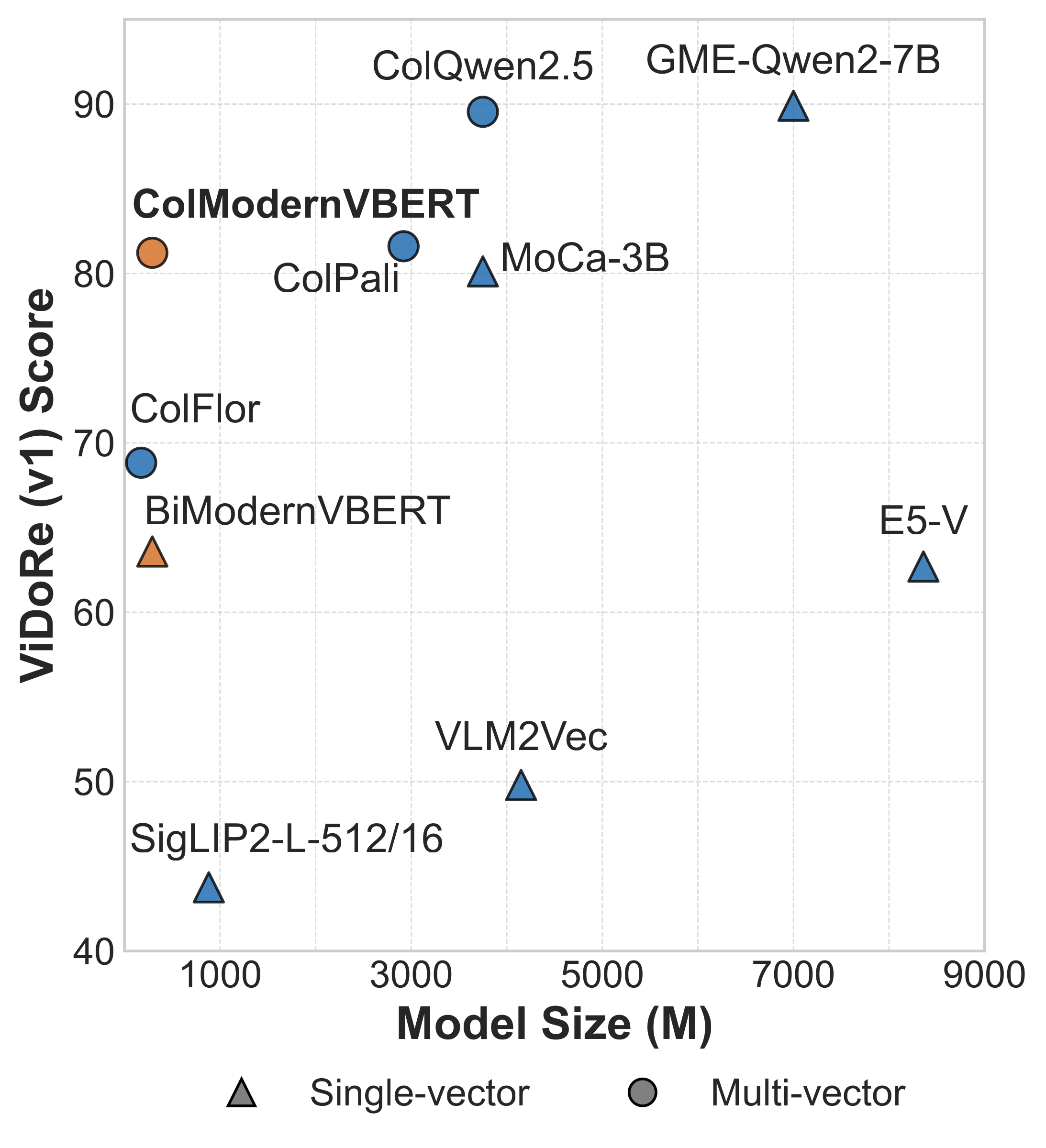
ColModernVBERT. The resulting model, ColModernVBERT, showcases strong performance on visual document retrieval benchmarks, especially relative to its size category (Figure 1). Despite having over 10 times fewer parameters than models such as ColPali released only a year ago, it is only 0.6 nDCG@5 points below on the aggregated ViDoRe benchmark scores (Table 3). It also edges many larger single-vector repurposed VLM models released within the year . It however falls short of top model performance on ViDoRe, which is achieved by larger decoder VLMs pretrained and aligned on billions of tokens of text and image data.
Most sub-1B parameter models evaluated on document retrieval benchmarks are dual encoder models, since early fusion generative models that perform well are not common at this scale. The most related model is a 176M late interaction model, ColFlor , trained from the Florence2 model . ColFlor is 12.7 nDCG@5 points under ColModernVBERT. ColModernVBERT also largely outperforms off-the-shelf dual encoders, even when those have substantially larger parameter counts. These results highlight the benefits of multi-phase training and early fusion architectures for multimodal document-related tasks, even at smaller parameter counts. We also attribute the strong performance of ColModernVBERT at smaller model sizes to the symbiosis of native bidirectional attention and Late Interaction matching, which largely boosts performance relative to comparable decoder models (Section 5.3.1).
Speed. As noted by , multi-vector visual retrievers are not bottlenecked in their inference speed by the late interaction matching operation, but rather by the latency required to encode queries with the text model. Our model demonstrates that strong performance is not incompatible with speed, even when running inference on consumer CPUs, which is the standard setting in most industrial local deployments of text embedding models. Latencies are computed by averaging query encoding times of all NanoBEIR queries, which are 23.4 words and 147.5 characters long on average, and are run with batch size 1 to replicate online use cases. To prevent RAM bottlenecks, we benchmark on very high RAM (2TB) CPU cloud environments, but note models larger than 3B parameters require more than 12 GB RAM to run optimally. (Table 3). ModernVBERT achieves more than a 7x speedup on CPU over models with similar performances on ViDoRe. We further report model latency results on GPU hardware in Appendix E.3.6.2. We notably demonstrate that with batched inference, ModernVBERT based query encoders are able to encode 5000 queries per second on Nvidia H100 GPUs. ModernVBert's small model size also enables efficient batching when encoding documents.
Related Work
Repurposing VLMs for Representation Learning. Motivated by the zero-shot performances of generative VLMs , recent studies have explored repurposing these for multimodal embedding tasks . As backbone generative models improved, retriever performance improved as well showcasing the central impact of language model pretraining and modality alignment .
These models remain inherently constrained by their causal attention mechanisms, which have been shown in text settings to limit representational efficiency . Recent work attempts to address this issue by modifying VLM attention during continual pretraining or contrastive tuning , but no recent work attempts to align natively bidirectional language encoder models with vision encoders. The recent release of long sequence text encoders makes this possible.
Late Interaction in Visual Document Retrieval To further boost performance, visual document retrievers leverage the late interaction mechanism which matches multiple query embeddings with multiple document embeddings through the MaxSim operation . This enables more granular interactions between image and query tokens, at the cost of additional storage and a slight compute overhead during the matching operation. Efficiency gains have come from improving the storage costs through quantization , token pruning and more recently the use of Matrioshka losses to compact multi-token representations . Ultimately, the performance bottleneck when running visual retrieval inference with such models now resides mostly in the necessity to rely on costly GPU hardware to encode queries, which sets apart text from vision retrieval. This paper fills this gap by using encoders that run on CPU, of parameter sizes comparable to commonly used local text embedding models .
Conclusion
In this paper, we question design decisions of current VLM-based retriever models, providing crucial insights into what matters when training early-fusion vision encoders. Our study notably shows that these models generally do not improve retrieval on natural-image tasks compared to dual encoders, yet strong vision-language alignment is essential for document-centric retrieval. We uncover a tight synergy between bidirectional attention and late-interaction retrieval, which underscores a fundamental limitation of repurposing decoder-style generative VLMs for retrieval. To mitigate data scarcity in contrastive learning, we propose augmenting limited image-document/text-query pairs with larger, lower-cost corpora from other modalities. Guided by these insights, we trained ColModernVBERT, a compact yet powerful M-parameter multimodal encoder that matches the performance of models up to larger on visual retrieval benchmarks. We release models and training code to help practitioners reduce cost and latency when deploying visual retrievers in real-world applications, and to encourage research on efficient multimodal embedding models.
Future Work & Limitations.
By design, our analysis targets relatively small models. An important next step is to test whether the observed patterns persist at larger scales—for example, to more rigorously probe the interplay between late interaction and bidirectional attention. Our study also focuses exclusively on English. While we expect the broad trends to generalize and see clear value in releasing multilingual variants, it remains unclear how allocating parameters to additional languages trades off against the understanding of the vision modality, and to what extent this penalizes English retrieval performance as the number of languages is scaled . Finally, although we center on retrieval and sequence-level zero-shot classification, the modality-aligned encoder can be fine-tuned for a range of token-level tasks, including OCR error detection, token-level classification, visual named entity recognition, visually grounded token-level object detection, contextual embeddings . We release our base model to encourage exploration of these directions.
References
- Haonan Chen, Hong Liu, Yuping Luo, Liang Wang, Nan Yang, Furu Wei, Zhicheng Dou (2025). MoCa: Modality-aware Continual Pre-training Makes Better Bidirectional Multimodal Embeddings. Source ↗
- Ziyan Jiang, Rui Meng, Xinyi Yang, Semih Yavuz, Yingbo Zhou, Wenhu Chen (2024). VLM2Vec: Training Vision-Language Models for Massive Multimodal Embedding Tasks. Source ↗
- Xin Zhang, Yanzhao Zhang, Wen Xie, Mingxin Li, Ziqi Dai, Dingkun Long, Pengjun Xie, Meishan Zhang, Wenjie Li, Min Zhang (2025). GME: Improving Universal Multimodal Retrieval by Multimodal LLMs. Source ↗
- Ting Jiang, Minghui Song, Zihan Zhang, Haizhen Huang, Weiwei Deng, Feng Sun, Qi Zhang, Deqing Wang, Fuzhen Zhuang (2024). E5-V: Universal Embeddings with Multimodal Large Language Models. Source ↗
- Manuel Faysse, Hugues Sibille, Tony Wu, Bilel Omrani, Gautier Viaud, Céline Hudelot, Pierre Colombo (2025). ColPali: Efficient Document Retrieval with Vision Language Models. International Conference on Learning Representations (ICLR 2025). Source ↗
- Michael Günther, Saba Sturua, Mohammad Kalim Akram, Isabelle Mohr, Andrei Ungureanu, Bo Wang, Sedigheh Eslami, Scott Martens, Maximilian Werk, Nan Wang, Han Xiao (2025). jina-embeddings-v4: Universal Embeddings for Multimodal Multilingual Retrieval. Source ↗
- Mengyao Xu, Gabriel Moreira, Ronay Ak, Radek Osmulski, Yauhen Babakhin, Zhiding Yu, Benedikt Schifferer, Even Oldridge (2025). Llama Nemoretriever Colembed: Top-Performing Text-Image Retrieval Model. Source ↗
- Andreas Koukounas, Georgios Mastrapas, Michael Günther, Bo Wang, Scott Martens, Isabelle Mohr, Saba Sturua, Mohammad Kalim Akram, Joan Fontanals Martínez, Saahil Ognawala, Susana Guzman, Maximilian Werk, Nan Wang, Han Xiao (2024). Jina CLIP: Your CLIP Model Is Also Your Text Retriever. arXiv. Source ↗
- Junjie Zhou, Zheng Liu, Shitao Xiao, Bo Zhao, Yongping Xiong (2024). VISTA: Visualized Text Embedding For Universal Multi-Modal Retrieval. Source ↗
- Michael Tschannen, Alexey Gritsenko, Xiao Wang, Muhammad Ferjad Naeem, Ibrahim Alabdulmohsin, Nikhil Parthasarathy, Talfan Evans, Lucas Beyer, Ye Xia, Basil Mustafa, Olivier Hénaff, Jeremiah Harmsen, Andreas Steiner, Xiaohua Zhai (2025). SigLIP 2: Multilingual Vision-Language Encoders with Improved Semantic Understanding, Localization, and Dense Features. Source ↗
- Ahmed Masry, Enamul Hoque (2024). ColFlor: Towards BERT-Size Vision-Language Document Retrieval Models.
- Nils Reimers, Iryna Gurevych (2019). Sentence-BERT: Sentence Embeddings using Siamese BERT-Networks. Proceedings of the 2019 Conference on Empirical Methods in Natural Language Processing and the 9th International Joint Conference on Natural Language Processing (EMNLP-IJCNLP). Source ↗
- Vladimir Karpukhin, Barlas Oguz, Sewon Min, Patrick Lewis, Ledell Wu, Sergey Edunov, Danqi Chen, Wen-tau Yih (2020). Dense Passage Retrieval for Open-Domain Question Answering. Proceedings of the 2020 Conference on Empirical Methods in Natural Language Processing (EMNLP). Source ↗
- Liang Wang, Nan Yang, Xiaolong Huang, Binxing Jiao, Linjun Yang, Daxin Jiang, Rangan Majumder, Furu Wei (2022). Text Embeddings by Weakly-Supervised Contrastive Pre-training. arXiv. Source ↗
- Patrick Lewis, Ethan Perez, Aleksandra Piktus, Fabio Petroni, Vladimir Karpukhin, Naman Goyal, Heinrich Küttler, Mike Lewis, Wen-tau Yih, Tim Rocktäschel, Sebastian Riedel, Douwe Kiela (2020). Retrieval-Augmented Generation for Knowledge-Intensive NLP Tasks. arXiv. Source ↗
- Weizhe Lin, Bill Byrne (2022). Retrieval Augmented Visual Question Answering with Outside Knowledge. Proceedings of the 2022 Conference on Empirical Methods in Natural Language Processing. Source ↗
- Jean-Baptiste Alayrac, Jeff Donahue, Pauline Luc, Antoine Miech, Iain Barr, Yana Hasson, Karel Lenc, Arthur Mensch, Katie Millican, Malcolm Reynolds, Roman Ring, Eliza Rutherford, Serkan Cabi, Tengda Han, Zhitao Gong, Sina Samangooei, Marianne Monteiro, Jacob Menick, Sebastian Borgeaud, Andrew Brock, Aida Nematzadeh, Sahand Sharifzadeh, Mikolaj Binkowski, Ricardo Barreira, Oriol Vinyals, Andrew Zisserman, Karen Simonyan (2022). Flamingo: a Visual Language Model for Few-Shot Learning. Source ↗
- Xueguang Ma, Sheng-Chieh Lin, Minghan Li, Wenhu Chen, Jimmy Lin (2024). Unifying Multimodal Retrieval via Document Screenshot Embedding. Source ↗
- Chankyu Lee, Rajarshi Roy, Mengyao Xu, Jonathan Raiman, Mohammad Shoeybi, Bryan Catanzaro, Wei Ping (2024). NV-Embed: Improved Techniques for Training LLMs as Generalist Embedding Models. Source ↗
- Hippolyte Gisserot-Boukhlef, Nicolas Boizard, Manuel Faysse, Duarte M. Alves, Emmanuel Malherbe, André F. T. Martins, Céline Hudelot, Pierre Colombo (2026). Should We Still Pretrain Encoders with Masked Language Modeling?. International Conference on Learning Representations (ICLR 2026). Source ↗
- Jason Wei, Yi Tay, Rishi Bommasani, Colin Raffel, Barret Zoph, Sebastian Borgeaud, Dani Yogatama, Maarten Bosma, Denny Zhou, Donald Metzler, Ed H. Chi, Tatsunori Hashimoto, Oriol Vinyals, Percy Liang, Jeff Dean, William Fedus (2022). Emergent Abilities of Large Language Models. Source ↗
- Benjamin Clavié (2024). Towards Better Monolingual Japanese Retrievers with Multi-Vector Models. Source ↗
- Cohere (2024). Introducing Rerank 3: A New Foundation Model for Efficient Enterprise Search & Retrieval. Source ↗
- Zeyuan Allen-Zhu, Yuanzhi Li (2025). Physics of Language Models: Part 1, Learning Hierarchical Language Structures. Source ↗
- Orion Weller, Kathryn Ricci, Marc Marone, Antoine Chaffin, Dawn Lawrie, Benjamin Van Durme (2025). Seq vs Seq: An Open Suite of Paired Encoders and Decoders. Source ↗
- Hugo Touvron, Louis Martin, Kevin Stone, Peter Albert, Amjad Almahairi, Yasmine Babaei, Nikolay Bashlykov, Soumya Batra, Prajjwal Bhargava, Shruti Bhosale, Dan Bikel, Lukas Blecher, Cristian Canton Ferrer, Moya Chen, Guillem Cucurull, David Esiobu, Jude Fernandes, Jeremy Fu, Wenyin Fu, Brian Fuller, Cynthia Gao, Vedanuj Goswami, Naman Goyal, Anthony Hartshorn, Saghar Hosseini, Rui Hou, Hakan Inan, Marcin Kardas, Viktor Kerkez, Madian Khabsa, Isabel Kloumann, Artem Korenev, Punit Singh Koura, Marie-Anne Lachaux, Thibaut Lavril, Jenya Lee, Diana Liskovich, Yinghai Lu, Yuning Mao, Xavier Martinet, Todor Mihaylov, Pushkar Mishra, Igor Molybog, Yixin Nie, Andrew Poulton, Jeremy Reizenstein, Rashi Rungta, Kalyan Saladi, Alan Schelten, Ruan Silva, Eric Michael Smith, Ranjan Subramanian, Xiaoqing Ellen Tan, Binh Tang, Ross Taylor, Adina Williams, Jian Xiang Kuan, Puxin Xu, Zheng Yan, Iliyan Zarov, Yuchen Zhang, Angela Fan, Melanie Kambadur, Sharan Narang, Aurelien Rodriguez, Robert Stojnic, Sergey Edunov, Thomas Scialom (2023). Llama 2: Open Foundation and Fine-Tuned Chat Models. Source ↗
- Junnan Li, Dongxu Li, Caiming Xiong, Steven Hoi (2022). BLIP: Bootstrapping Language-Image Pre-training for Unified Vision-Language Understanding and Generation. Source ↗
- Peng Wang, Shuai Bai, Sinan Tan, Shijie Wang, Zhihao Fan, Jinze Bai, Keqin Chen, Xuejing Liu, Jialin Wang, Wenbin Ge, Yang Fan, Kai Dang, Mengfei Du, Xuancheng Ren, Rui Men, Dayiheng Liu, Chang Zhou, Jingren Zhou, Junyang Lin (2024). Qwen2-VL: Enhancing Vision-Language Model's Perception of the World at Any Resolution. Source ↗
- An Yang, Bowen Yu, Chengyuan Li, Dayiheng Liu, Fei Huang, Haoyan Huang, Jiandong Jiang, Jianhong Tu, Jianwei Zhang, Jingren Zhou, Junyang Lin, Kai Dang, Kexin Yang, Le Yu, Mei Li, Minmin Sun, Qin Zhu, Rui Men, Tao He, Weijia Xu, Wenbiao Yin, Wenyuan Yu, Xiafei Qiu, Xingzhang Ren, Xinlong Yang, Yong Li, Zhiying Xu, Zipeng Zhang (2025). Qwen2.5-1M Technical Report. Source ↗
- Andrés Marafioti, Orr Zohar, Miquel Farré, Merve Noyan, Elie Bakouch, Pedro Cuenca, Cyril Zakka, Loubna Ben Allal, Anton Lozhkov, Nouamane Tazi, Vaibhav Srivastav, Joshua Lochner, Hugo Larcher, Mathieu Morlon, Lewis Tunstall, Leandro von Werra, Thomas Wolf (2025). SmolVLM: Redefining small and efficient multimodal models. Source ↗
- Ziyi Lin, Chris Liu, Renrui Zhang, Peng Gao, Longtian Qiu, Han Xiao, Han Qiu, Chen Lin, Wenqi Shao, Keqin Chen, Jiaming Han, Siyuan Huang, Yichi Zhang, Xuming He, Hongsheng Li, Yu Qiao (2023). SPHINX: The Joint Mixing of Weights, Tasks, and Visual Embeddings for Multi-modal Large Language Models. Source ↗
- Jiabo Ye, Anwen Hu, Haiyang Xu, Qinghao Ye, Ming Yan, Guohai Xu, Chenliang Li, Junfeng Tian, Qi Qian, Ji Zhang, Qin Jin, Liang He, Xin Alex Lin, Fei Huang (2023). UReader: Universal OCR-free Visually-situated Language Understanding with Multimodal Large Language Model. Source ↗
- Alexey Dosovitskiy, Lucas Beyer, Alexander Kolesnikov, Dirk Weissenborn, Xiaohua Zhai, Thomas Unterthiner, Mostafa Dehghani, Matthias Minderer, Georg Heigold, Sylvain Gelly, Jakob Uszkoreit, Neil Houlsby (2020). An Image is Worth 16x16 Words: Transformers for Image Recognition at Scale. Source ↗
- Wenzhe Shi, Jose Caballero, Ferenc Huszár, Johannes Totz, Andrew P. Aitken, Rob Bishop, Daniel Rueckert, Zehan Wang (2016). Real-Time Single Image and Video Super-Resolution Using an Efficient Sub-Pixel Convolutional Neural Network. Source ↗
- Haotian Liu, Chunyuan Li, Qingyang Wu, Yong Jae Lee (2023). Visual Instruction Tuning. Source ↗
- Alec Radford, Jong Wook Kim, Chris Hallacy, Aditya Ramesh, Gabriel Goh, Sandhini Agarwal, Girish Sastry, Amanda Askell, Pamela Mishkin, Jack Clark, Gretchen Krueger, Ilya Sutskever (2021). Learning Transferable Visual Models From Natural Language Supervision. Source ↗
- Edward J. Hu, Yelong Shen, Phillip Wallis, Zeyuan Allen-Zhu, Yuanzhi Li, Shean Wang, Lu Wang, Weizhu Chen (2021). LoRA: Low-Rank Adaptation of Large Language Models. Source ↗
- Hugo Laurençon, Léo Tronchon, Matthieu Cord, Victor Sanh (2024). What matters when building vision-language models?. arXiv. Source ↗
- Brandon McKinzie, Zhe Gan, Jean-Philippe Fauconnier, Sam Dodge, Bowen Zhang, Philipp Dufter, Dhruti Shah, Xianzhi Du, Futang Peng, Floris Weers, Anton Belyi, Haotian Zhang, Karanjeet Singh, Doug Kang, Hongyu Hè, Max Schwarzer, Tom Gunter, Xiang Kong, Aonan Zhang, Jianyu Wang, Chong Wang, Nan Du, Tao Lei, Sam Wiseman, Mark Lee, Zirui Wang, Ruoming Pang, Peter Grasch, Alexander Toshev, Yinfei Yang (2024). MM1: Methods, Analysis & Insights from Multimodal LLM Pre-training. Source ↗
- Hugo Laurençon, Andrés Marafioti, Victor Sanh, Léo Tronchon (2024). Building and better understanding vision-language models: insights and future directions..
- Haotian Liu, Chunyuan Li, Yuheng Li, Yong Jae Lee (2023). Improved Baselines with Visual Instruction Tuning. arXiv. Source ↗
- Mathew Huerta-Enochian, Seung Yong Ko (2024). Instruction Fine-Tuning: Does Prompt Loss Matter?. Source ↗
- Zhengyan Shi, Adam X. Yang, Bin Wu, Laurence Aitchison, Emine Yilmaz, Aldo Lipani (2024). Instruction Tuning With Loss Over Instructions. Source ↗
- Loubna Ben Allal, Anton Lozhkov, Elie Bakouch, Gabriel Martín Blázquez, Guilherme Penedo, Lewis Tunstall, Andrés Marafioti, Hynek Kydlíček, Agustín Piqueres Lajarín, Vaibhav Srivastav, Joshua Lochner, Caleb Fahlgren, Xuan-Son Nguyen, Clémentine Fourrier, Ben Burtenshaw, Hugo Larcher, Haojun Zhao, Cyril Zakka, Mathieu Morlon, Colin Raffel, Leandro von Werra, Thomas Wolf (2025). SmolLM2: When Smol Goes Big – Data-Centric Training of a Small Language Model. Source ↗
- Shengding Hu, Yuge Tu, Xu Han, Chaoqun He, Ganqu Cui, Xiang Long, Zhi Zheng, Yewei Fang, Yuxiang Huang, Weilin Zhao, Xinrong Zhang, Zheng Leng Thai, Kaihuo Zhang, Chongyi Wang, Yuan Yao, Chenyang Zhao, Jie Zhou, Jie Cai, Zhongwu Zhai, Ning Ding, Chao Jia, Guoyang Zeng, Dahai Li, Zhiyuan Liu, Maosong Sun (2024). MiniCPM: Unveiling the Potential of Small Language Models with Scalable Training Strategies. Source ↗
- Tsung-Yi Lin, Michael Maire, Serge Belongie, Lubomir Bourdev, Ross Girshick, James Hays, Pietro Perona, Deva Ramanan, C. Lawrence Zitnick, Piotr Dollár (2014). Microsoft COCO: Common Objects in Context. arXiv. Source ↗
- Aaron van den Oord, Yazhe Li, Oriol Vinyals (2018). Representation Learning with Contrastive Predictive Coding. arXiv. Source ↗
- Zehan Li, Xin Zhang, Yanzhao Zhang, Dingkun Long, Pengjun Xie, Meishan Zhang (2023). Towards General Text Embeddings with Multi-stage Contrastive Learning. Source ↗
- Quentin Macé, António Loison, Manuel Faysse (2026). ViDoRe Benchmark V2: Raising the Bar for Visual Retrieval. Annual Meeting of the Association for Computational Linguistics (ACL 2026). Source ↗
- Chenghao Xiao, Isaac Chung, Imene Kerboua, Jamie Stirling, Xin Zhang, Márton Kardos, Roman Solomatin, Noura Al Moubayed, Kenneth Enevoldsen, Niklas Muennighoff (2025). MIEB: Massive Image Embedding Benchmark. Source ↗
- Bryan A. Plummer, Liwei Wang, Chris M. Cervantes, Juan C. Caicedo, Julia Hockenmaier, Svetlana Lazebnik (2015). Flickr30k Entities: Collecting Region-to-Phrase Correspondences for Richer Image-to-Sentence Models. arXiv. Source ↗
- Niklas Muennighoff, Nouamane Tazi, Loic Magne, Nils Reimers (2022). MTEB: Massive Text Embedding Benchmark. arXiv. Source ↗
- Jonathan Krause, Michael Stark, Jia Deng, Li Fei-Fei (2013). 3D Object Representations for Fine-Grained Categorization. 2013 IEEE International Conference on Computer Vision Workshops. Source ↗
- Lukas Bossard, Matthieu Guillaumin, Luc Van Gool (2014). Food-101 – Mining Discriminative Components with Random Forests. Computer Vision – ECCV 2014.
- Yousif Khaireddin, Zhuofa Chen (2021). Facial Emotion Recognition: State of the Art Performance on FER2013. Source ↗
- Patrick Helber, Benjamin Bischke, Andreas Dengel, Damian Borth (2019). EuroSAT: A Novel Dataset and Deep Learning Benchmark for Land Use and Land Cover Classification. Source ↗
- Lucas Beyer, Andreas Steiner, André Susano Pinto, Alexander Kolesnikov, Xiao Wang, Daniel Salz, Maxim Neumann, Ibrahim Alabdulmohsin, Michael Tschannen, Emanuele Bugliarello, Thomas Unterthiner, Daniel Keysers, Skanda Koppula, Fangyu Liu, Adam Grycner, Alexey Gritsenko, Neil Houlsby, Manoj Kumar, Keran Rong, Julian Eisenschlos, Rishabh Kabra, Matthias Bauer, Matko Bošnjak, Xi Chen, Matthias Minderer, Paul Voigtlaender, Ioana Bica, Ivana Balazevic, Joan Puigcerver, Pinelopi Papalampidi, Olivier Henaff, Xi Xiong, Radu Soricut, Jeremiah Harmsen, Xiaohua Zhai (2024). PaliGemma: A versatile 3B VLM for transfer. Source ↗
- Omar Khattab, Matei Zaharia (2020). ColBERT: Efficient and Effective Passage Search via Contextualized Late Interaction over BERT. Proceedings of the 43rd International ACM SIGIR Conference on Research and Development in Information Retrieval. Source ↗
- Anwen Hu, Haiyang Xu, Liang Zhang, Jiabo Ye, Ming Yan, Ji Zhang, Qin Jin, Fei Huang, Jingren Zhou (2024). mPLUG-DocOwl2: High-resolution Compressing for OCR-free Multi-page Document Understanding. Source ↗
- Benjamin Warner, Antoine Chaffin, Benjamin Clavié, Orion Weller, Oskar Hallström, Said Taghadouini, Alexis Gallagher, Raja Biswas, Faisal Ladhak, Tom Aarsen, Nathan Cooper, Griffin Adams, Jeremy Howard, Iacopo Poli (2024). Smarter, Better, Faster, Longer: A Modern Bidirectional Encoder for Fast, Memory Efficient, and Long Context Finetuning and Inference. Source ↗
- Bin Xiao, Haiping Wu, Weijian Xu, Xiyang Dai, Houdong Hu, Yumao Lu, Michael Zeng, Ce Liu, Lu Yuan (2023). Florence-2: Advancing a Unified Representation for a Variety of Vision Tasks. Source ↗
- Zilin Xiao, Qi Ma, Mengting Gu, Chun-cheng Jason Chen, Xintao Chen, Vicente Ordonez, Vijai Mohan (2025). MetaEmbed: Scaling Multimodal Retrieval at Test-Time with Flexible Late Interaction. Source ↗
- Lucas Beyer*, Andreas Steiner*, André Susano Pinto*, Alexander Kolesnikov*, Xiao Wang*, Xiaohua Zhai*, Daniel Salz, Maxim Neumann, Ibrahim Alabdulmohsin, Michael Tschannen, Jeremiah Harmsen, Daniel Keysers, Neil Houlsby, Xi Chen, Emanuele Bugliarello, Thomas Unterthiner, Keran Rong, Matthias Minderer, Ioana Bica, Ivana Balazevic, Joan Puigcerver, Julian Eisenschlos, Manoj Kumar, Matko Bošnjak, Matthias Bauer, Fangyu Liu, Adam Grycner, Alexey Gritsenko, Paul Voigtlaender, Pinelopi Papalampidi, Olivier Henaff, Skanda Koppula, Xi Xiong, Radu Soricut, Model release contributors, general support, Tris Warkentin, Kat Black, Luiz Gustavo Martins, Glenn Cameron, Raj Gundluru, Manvinder Singh, Meg Risdal, Nilay Chauhan, Nate Keating, Nesh Devanathan, Elisa Bandy, Joe Fernandez, Antonia Paterson, Jenny Brennan, Tom Eccles, Pankil Botadra, Ben Bariach, Lav Rai, Minwoo Park, Dustin Luong, Daniel Vlasic, Bo Wu, Wenming Ye, Divyashree Sreepathihalli, Kiranbir Sodhia, Alek Andreev, Armand Joulin, Surya Bhupatiraju, Minh Giang, Joelle Barral, Zoubin Ghahramani (2024). PaliGemma. Kaggle. Source ↗
- Jinze Bai, Shuai Bai, Shusheng Yang, Shijie Wang, Sinan Tan, Peng Wang, Junyang Lin, Chang Zhou, Jingren Zhou (2023). Qwen-VL: A Versatile Vision-Language Model for Understanding, Localization, Text Reading, and Beyond. Source ↗
- Zach Nussbaum, John X. Morris, Brandon Duderstadt, Andriy Mulyar (2024). Nomic Embed: Training a Reproducible Long Context Text Embedder. Source ↗
- Nicolas Boizard, Hippolyte Gisserot-Boukhlef, Duarte M. Alves, André Martins, Ayoub Hammal, Caio Corro, Céline Hudelot, Emmanuel Malherbe, Etienne Malaboeuf, Fanny Jourdan, Gabriel Hautreux, João Alves, Kevin El-Haddad, Manuel Faysse, others (2025). EuroBERT: Scaling Multilingual Encoders for European Languages. Conference on Language Modeling (COLM 2025). Source ↗
- Jo Bergum (2025). Scaling ColPali to billions of PDFs with Vespa — blog.vespa.ai.
- Manuel Faysse, Patrick Fernandes, Nuno M. Guerreiro, António Loison, Duarte M. Alves, Caio Corro, Nicolas Boizard, João Alves, Ricardo Rei, Pedro H. Martins, Antoni Bigata Casademunt, François Yvon, André F. T. Martins, Gautier Viaud, Céline Hudelot, Pierre Colombo (2025). CroissantLLM: A Truly Bilingual French-English Language Model. Source ↗
- Jianlv Chen, Shitao Xiao, Peitian Zhang, Kun Luo, Defu Lian, Zheng Liu (2024). BGE M3-Embedding: Multi-Lingual, Multi-Functionality, Multi-Granularity Text Embeddings Through Self-Knowledge Distillation. arXiv. Source ↗
- Kenneth Enevoldsen, Isaac Chung, Imene Kerboua, Márton Kardos, Ashwin Mathur, David Stap, Jay Gala, Wissam Siblini, Dominik Krzemiński, Genta Indra Winata, Saba Sturua, Saiteja Utpala, Mathieu Ciancone, Marion Schaeffer, Gabriel Sequeira, Diganta Misra, Shreeya Dhakal, Jonathan Rystrøm, Roman Solomatin, Ömer Çağatan, Akash Kundu, Martin Bernstorff, Shitao Xiao, Akshita Sukhlecha, Bhavish Pahwa, Rafał Poświata, Kranthi Kiran GV, Shawon Ashraf, Daniel Auras, Björn Plüster, Jan Philipp Harries, Loic Magne, Isabelle Mohr, Mariya Hendriksen, Dawei Zhu, Hippolyte Gisserot-Boukhlef, Tom Aarsen, Jan Kostkan, Konrad Wojtasik, Taemin Lee, Marek Šuppa, Crystina Zhang, Roberta Rocca, Mohammed Hamdy, Andrianos Michail, John Yang, Manuel Faysse, others (2025). MMTEB: Massive Multilingual Text Embedding Benchmark. International Conference on Learning Representations (ICLR 2025). Source ↗
- Patrick Fernandes, Behrooz Ghorbani, Xavier Garcia, Markus Freitag, Orhan Firat (2023). Scaling Laws for Multilingual Neural Machine Translation. Proceedings of the 40th International Conference on Machine Learning. Source ↗
- Max Conti*, Manuel Faysse*, Gautier Viaud, Antoine Bosselut, Céline Hudelot, Pierre Colombo (2025). Context is Gold to find the Gold Passage: Evaluating and Training Contextual Document Embeddings. (Oral, EMNLP 2025) Conference on Empirical Methods in Natural Language Processing. Source ↗