Appendices
Appendix E
ModernVBert Appendix
Training
Implementation and Resources
| Model | Batch Size | Learning Rate | Training Steps | Training GPU Hours |
| Modality Alignment | ||||
| ModernVBERT-base (Table 2) | 4096 | 1e-4 | 5500 | 1920h |
| Contrastive Learning | ||||
| Generalist contrastive training (Table 4) | 256 | 2e-4 | 3917 | 80h |
| Document Specialization | ||||
| Document-focused contrastive training w/ hard negatives (Table 4) | 64 | 2e-4 | 19602 | 160h |
We list hyperparameters and resource details in Table 1 for the various training stages of our final models. We employ ZeRO stage 1 optimizer for our modality alignment runs. All ablation models are contrastively trained with gradient checkpointing to reduce memory usage. All training runs are performed with FlashAttention 2.0 . For LoRA configurations, we consistently use a rank r of , lora\_alpha of , and a dropout of . For the implementation, we start from m4 and ColPali codebases for training, and use the MTEB repository for evaluation.
Similarity Functions
Single-Vector Similarity. For single-vector models, we apply mean pooling for MLM-aligned encoders and end-of-sequence (EOS) pooling for CLM-based models and compute the cosine similarity of a query and a document as
Multi-Vector Similarity. For multi-vector models, we adopt the standard late-interaction scoring function defined as:
where and denote token-level embeddings for the query and document, respectively.
Data
Modality Alignment Mixture
For our modality alignment trainings, we rely on The Cauldron dataset and its Docmatix extension . Table 2 provides further details on the constitution of this dataset.
| Dataset Subsection | # Images | # QA Pairs | # Tokens | % Mix |
| Captioning | 609843 | 612768 | 62906011 | 3.13 |
| Real-world VQA | 457360 | 2125615 | 23318335 | 1.16 |
| OCR, Document Understanding | 2499258 | 11415478 | 426806479 | 21.21 |
| Chart/Figure Understanding | 539743 | 24444120 | 30315784 | 1.51 |
| Table Understanding | 163568 | 229077 | 21371931 | 1.06 |
| Reasoning, Logic, Maths | 490870 | 2212629 | 32450213 | 1.61 |
| Screenshot to Code | 547974 | 548296 | 336299551 | 16.71 |
| Text-only Instructions | 0 | 21482682 | 1079001075 | 53.61 |
| Total | 5308616 | 63070665 | 2012469379 | 100.00 |
NatCap
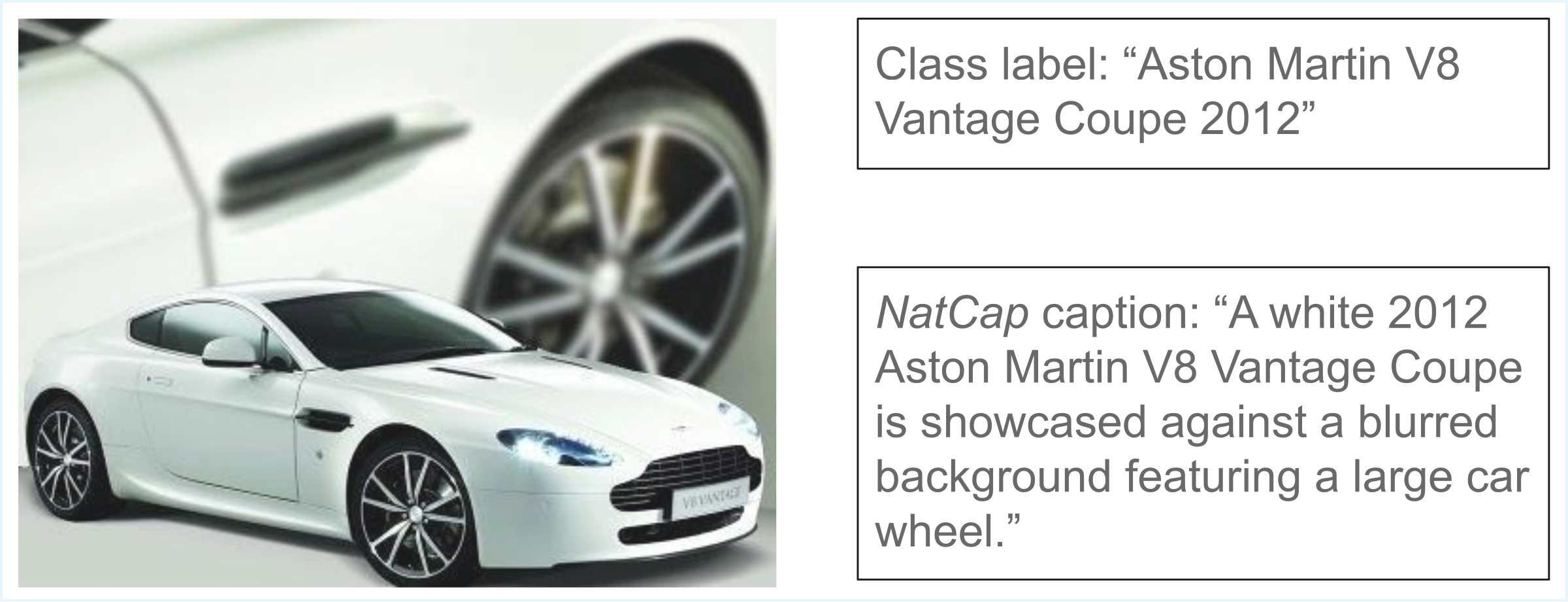
To enrich our contrastive learning data mixture, we construct NatCap (Natural Captions), a large-scale dataset containing around 333000 contextualized image–caption pairs. This dataset is created by generating synthetic captions, along with cross-class and in-class discriminative tags, from existing image classification datasets (see Table 3). For this purpose, we leverage Gemini-flash-2.5 which produces captions conditioned on both the image content and the accompanying dataset metadata, as illustrated in Figure 1. We detail the prompt below.
| Dataset | Description | # Items |
| Caltech101 | General objects. | 3000 |
| Caltech256 | General objects. | 30000 |
| Cars | Car model classification. | 8000 |
| Country211 | Country where the picture is taken. | 28000 |
| DTD | Describable textures (texture attributes). | 4000 |
| EuroSat | Land use / area zone type. | 16000 |
| FER2013 | Facial emotion recognition. | 28000 |
| FGCVAircraft | Aircraft model recognition. | 3000 |
| Food101 | Food categories. | 75000 |
| OxfordPets | Dog/cat species. | 3000 |
| RESISC45 | Aerial scene / area zone type. | 18000 |
| SUN397 | General scenes. | 109000 |
| VOC2007 | General objects. | 8000 |
| TOTAL | 333000 |
Contrastive Training Mix
In this subsection, we describe the composition of our data mixes used in the contrastive training stages. Table 4 outlines the datasets included in each mix, including the Document-Focused variant employed for ColModernVBERT.
| Source | Description | Pairs | Epochs |
| Generalist Mix | |||
| ColPali (Faysse et al. 2025) | Query–Document images for visual retrieval | 118k | 1 |
| MSCOCO (Lin et al. 2014) | Natural images with human-written captions | 118k | 1 |
| NatCap (ours, subsampled) | Diverse images with synthetic captions | 118k | 1 |
| RLHN (Thakur et al. 2025) | Text–text pairs for complex retrieval | 680k | 1 |
| TOTAL | 1030k | ||
| Document-Focused Mix | |||
| ColPali (Faysse et al. 2025) | Query–Document images for visual retrieval | 118k | 3 |
| RLHN (Thakur et al. 2025) | Text–text pairs for complex retrieval | 300k | 3 |
| TOTAL | 1254k | ||
Baselines Details
In this section, we describe the models evaluated in as comparison to our document retriever model.
MoCa-3B . A modality-aware continual pretraining model that transforms a causal vision-language model into a bidirectional multimodal embedding model, using interleaved image-text reconstruction and contrastive alignment to support cross-modal retrieval.
GME-Qwen2 . A unified multimodal embedder built on Qwen2-VL , which produces shared embedding representations across text, image, and fused input modalities, enabling universal multimodal retrieval.
VLM2Vec . A method that trains a vision-language encoder by converting a VLM through extensive contrastive post-training. Flagship model is based on the model Phi-3.5 .
E5-V . An adaptation of the E5 embedding approach to multimodal models: it trains only on text pairs yet bridges the modality gap to handle image inputs, reducing cost while achieving universal embeddings.
ColPali . A vision-based document retrieval model that processes document pages as images (no OCR) and produces multi-vector embeddings via a late-interaction mechanism over PaliGemma , enabling efficient and accurate retrieval.
ColQwen2.5 . An extension of ColPali using Qwen2-VL as the backbone, carrying forward the late interaction retrieval paradigm over page image embeddings, capturing layout and textual context without OCR.
Jina-v4 . A multimodal embedding model combining visual and textual inputs with support for multi-vector (late interaction) embeddings, using adapters over a unified backbone to excel on visually rich document retrieval.
NemoRetriever . An LI retriever that combines vision-language embeddings with a ColEmbed design, enabling high performance on visual document retrieval with structured patch matching and efficient similarity.
Jina CLIP . A smaller scale vision-language model using CLIP embeddings, applied to document retrieval tasks; although not LI, it offers a lightweight multimodal baseline.
BGE Visualized M3 . A vision-enhanced version of BGE M3 that supports visual inputs and extends embedding models into multimodal domains.
SigLIP2-L-512/16 . A multilingual vision-language bi-encoder model, which combines image and text modalities to yield unified embeddings across languages. This configuration handles images of 512x512 pixels and create subpatches of 16x16 pixels.
ColFlor . A lightweight OCR-free visual document retriever with only 174M parameters built over Florence-2 and DaViT, delivering strong performance near ColPali with much lower computational cost and much faster encoding.
Additional Ablations
Performance Against Off-the-Shelf Dual Encoder
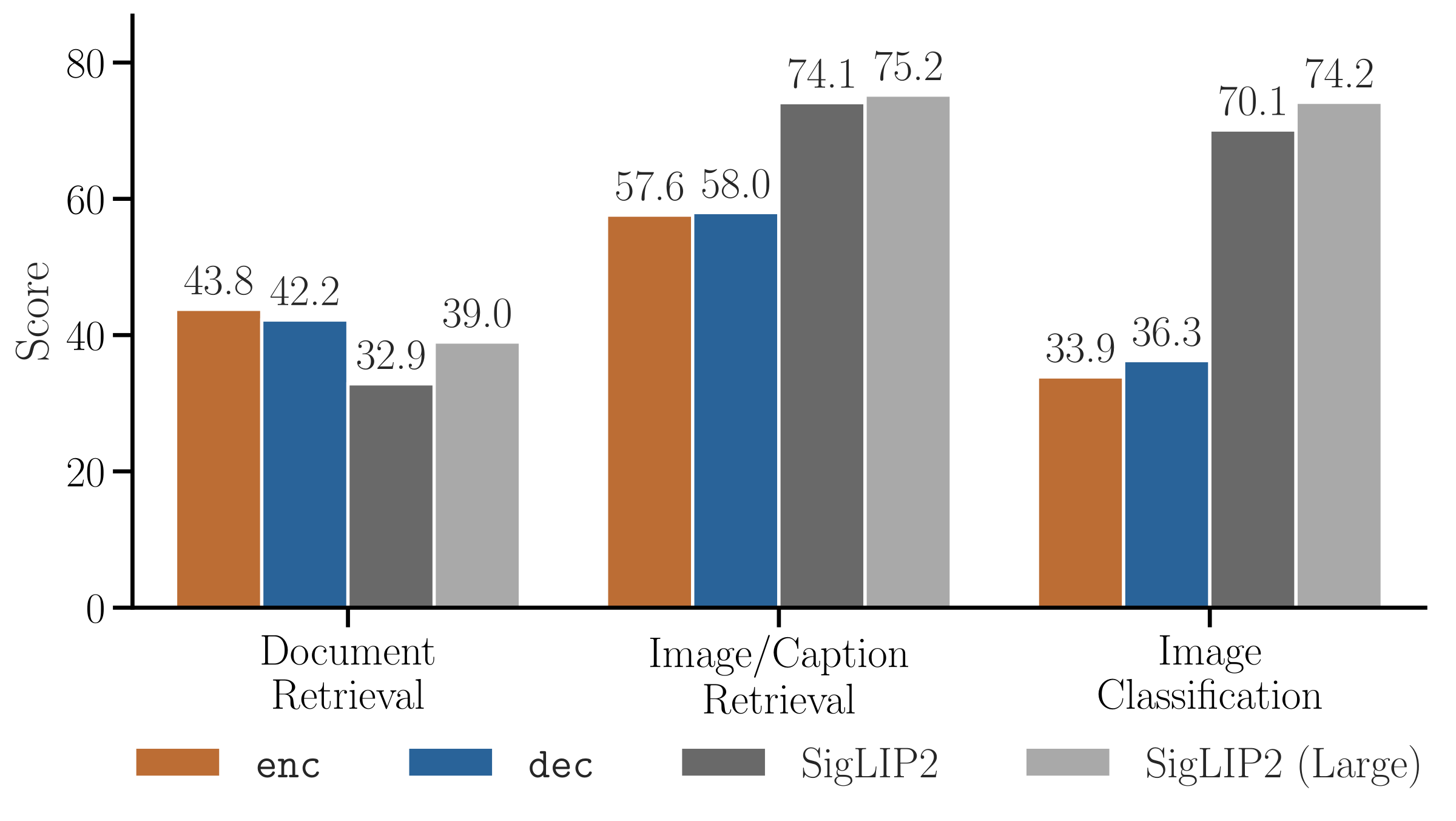
We study whether the off-the-shelf performance of the standalone vision tower outweighs the burden of adding language parameters and re-training through language modeling, as proposed in our work. Figure 2 shows the results of the various models on the tasks described in Section 5.2. Similarly to Section 5.3.1, we observe that the early fusion model trained with an LM objective significantly outperforms the standalone vision tower on document retrieval tasks (+10.9 nDCG@5). It even surpasses the larger dual encoder (+4.8 nDCG@5) on these latter tasks. We note that the standalone vision tower largely outperforms the early fusion models on the other natural-image tasks, supporting the use of the SigLIP model for these tasks as found in various general benchmarks .
Scaling Dynamics of Attention Masks
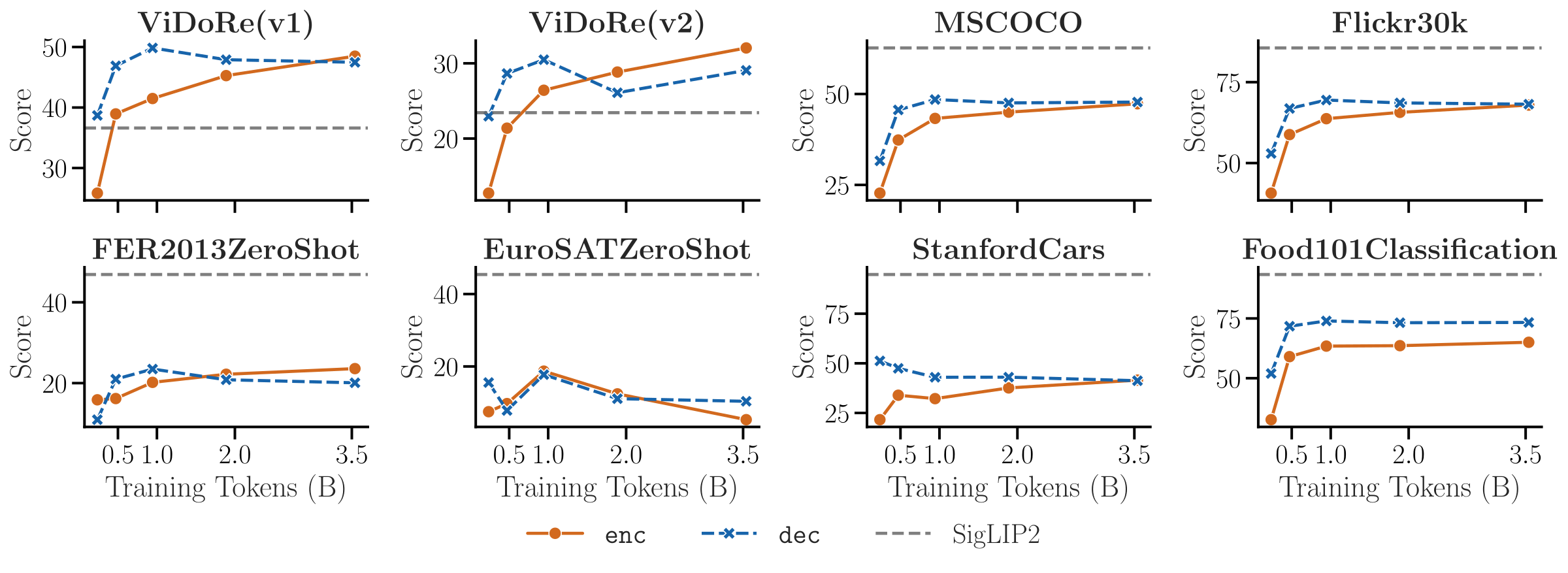
We study the different training dynamics of the different training objectives. We compare the enc (MLM) approach with a traditional dec (CLM) objective. Figure 3 presents the performance of the two training objectives across a diverse set of tasks. While starting dec offers an advantage in low-data regimes, enc seems to catch up. In document retrieval tasks, it eventually surpasses dec and scales better.
Bridging the Gap with Longer Contrastive Training
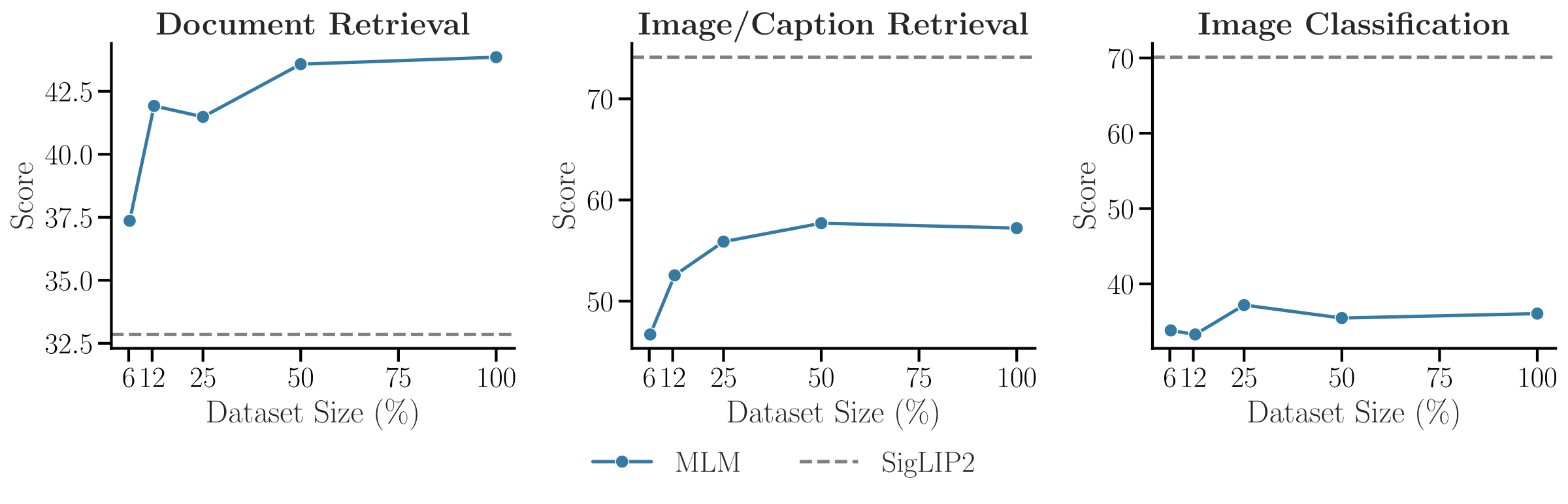
We study the impact of additional in-distribution training pairs on embedding tasks by scaling the contrastive training stage. Starting from the final checkpoint of our encoder-based ablation model, we double the contrastive dataset size at each step and train until convergence. This setup tests whether scaling continues to improve performance. Figure 4 shows the scaling behavior. Performance improves overall with more in-distribution data. The vision-tower baseline is quickly surpassed on visual document benchmarks, and scaling narrows the gap on other tasks. We note a plateau in captioning and classification, pointing to the need for more diverse data.
Optimal Text-To-Image Ratio for Document Retrieval
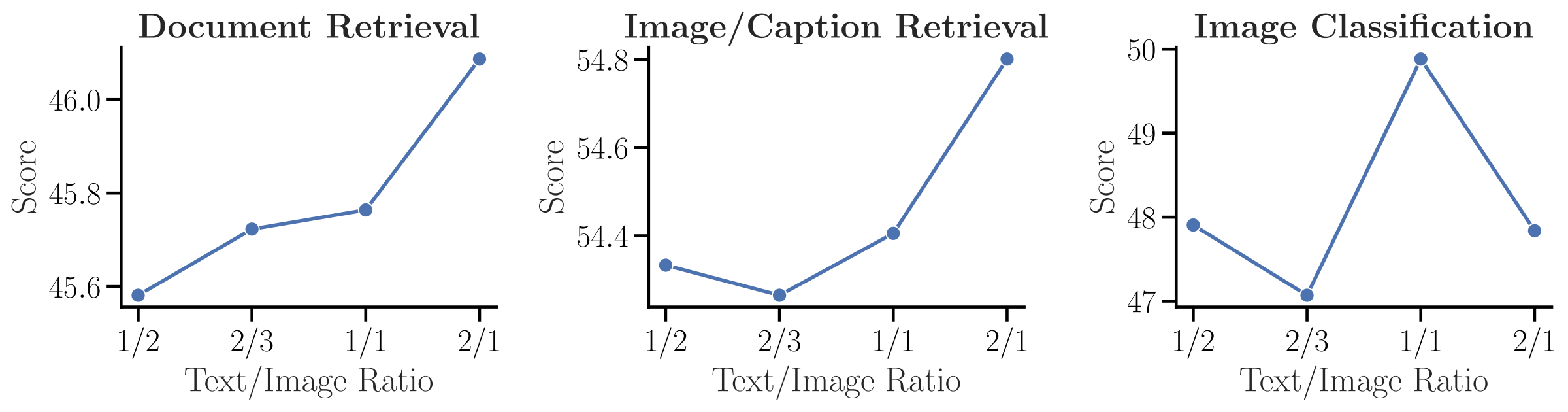
Our findings in subsection section indicate that incorporating additional text-only pairs boosts document retrieval performance. While our initial experiment employed a 1:1 text-to-image ratio, we further investigate how varying this ratio impacts our broad set of tasks. We start from the best contrastive mix in Table 1, and vary the text-to-image ratio. As shown in Figure 5, increasing the number of text-only pairs for a fixed amount of image pairs consistently enhances retrieval performance. However, for natural image classification tasks, adding more text does not appear to provide benefits.
Late Interaction for Non-Documental Retrieval
| Document Retrieval | Image/Caption Retrieval | |||||
| Model Size | ViDoRe(v1) | ViDoRe(v2) | MSCOCO (TI) | Flickr30k (TI) | Average | |
| CLIP Encoders | ||||||
| siglip2-base-patch16-512 | 376M | 36.6 | 23.4 | 66.2 | 86.9 | 53.3 |
| siglip2-large-patch16-512 | 882M | 43.8 | 27.0 | 67.1 | 88.9 | 56.7 |
| clip-vit-base-patch16 | 151M | 25.5 | 20.4 | 50.3 | 76.8 | 43.3 |
| clip-vit-large-patch14 | 428M | 38.0 | 28.6 | 52.7 | 79.3 | 49.6 |
| VLM-based Encoders | ||||||
| VLM2Vec-Full | 4150M | 49.8 | 36.5 | 59.5 | 81.8 | 56.9 |
| e5-v | 8360M | 62.7 | 49.4 | 68.1 | 89.8 | 67.5 |
| Early Fusion Encoders | ||||||
| bge-visualized-base | 196M | 10.3 | 9.0 | 50.0 | 74.1 | 35.9 |
| bge-visualized-m3 | 873M | 12.4 | 10.2 | 39.6 | 69.0 | 32.8 |
| ModernVBERT-embed | 252M | 58.4 | 36.9 | 56.5 | 76.0 | 56.9 |
| ModernVBERT-embed (multi-vector) | 252M | 76.5 | 53.9 | 61.8 | 81.4 | 68.4 |
We want to study if the multi-vector gains transfer to non-documental retrieval. To do so, we contrastively post-train our base model on our generalist post-training mix presented in Table 4. The late interaction generalist exhibits superior performance in retrieval setting, improving its single-vector performance by +20.2% (11.5 points), matching the performance of substantially larger VLM-based retrievers like E5-V (8.3B parameters, 67.5 points) and surpassing dual encoders like SigLIP (882M parameters, 56.7 points). This matches the capabilities observed in Section 5.3.1 for documental settings for models with native bidirectional attention, extending it to natural image tasks. This result extends the prevailing understanding from the document retrieval community, where the superiority of late-interaction is well-documented ((Khattab & Zaharia 2020), (Chaffin 2025), (Faysse et al. 2025)). While this performance gap is widely accepted for document retrieval, its applicability to caption matching tasks has not really been addressed. Our findings provide strong evidence that the fine-grained matching capabilities of late-interaction models are a key driver of performance in this domain too.
Model Merging
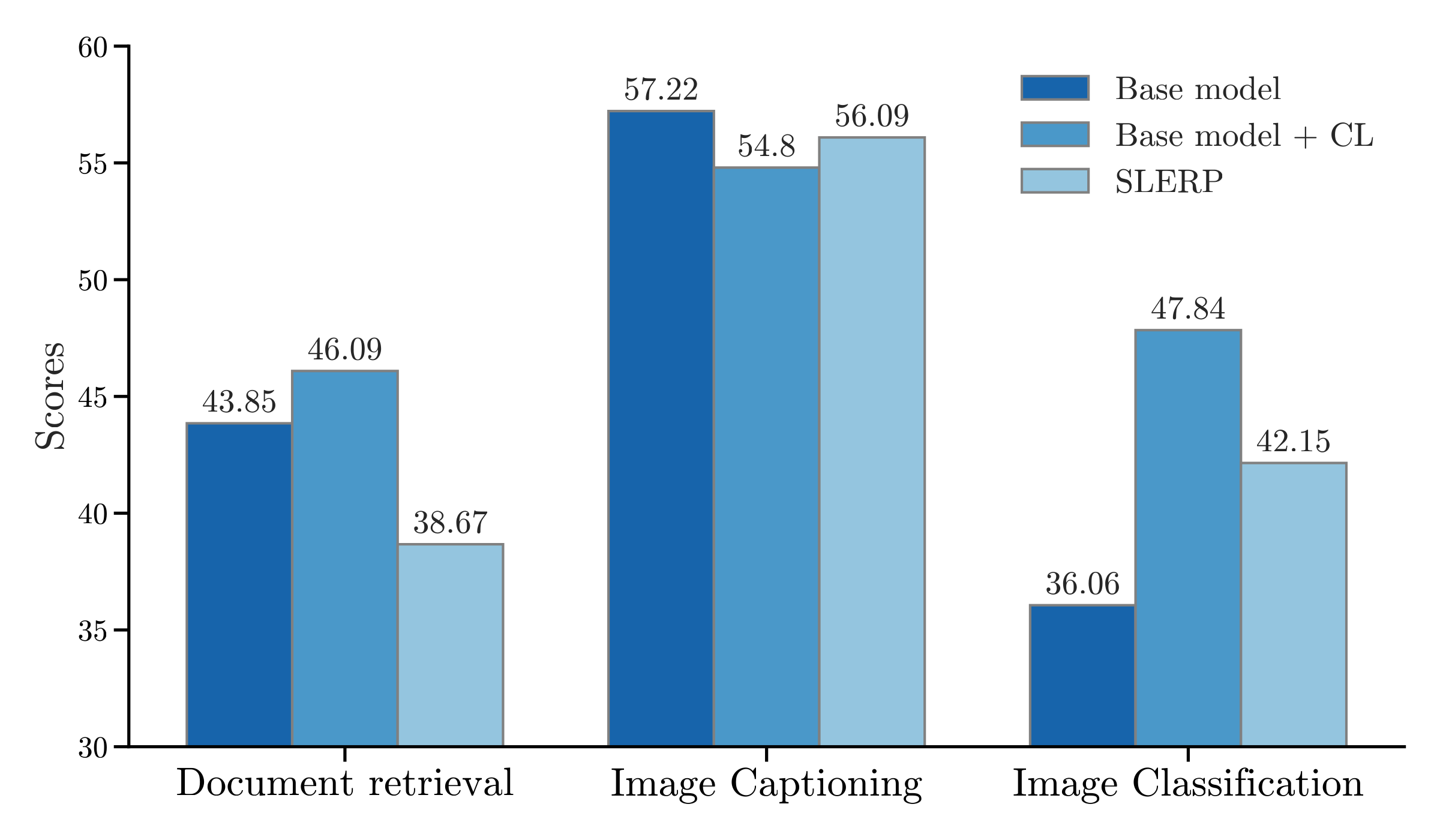
Our contrastive learning stage provides direct performance trade-offs on different tasks. Following recent trends, we evaluate how model merging techniques help mitigate performance degradation on specific tasks, while maintaining the performance enabled by the contrastive training . We merge our ablation model after modality alignment with the checkpoint after the full contrastive learning with two methods: SLERP and average merging . For SLERP, we compare three values for the coefficient (, , ). Figure 6 displays the trends with the best method (SLERP, ). As we can see, the merged model mitigates the performance drop in Image/Caption Retrieval tasks, while maintaining significant gains on Image Classification tasks. However, merging strongly degrades performance on Document Retrieval, showing that benefits of merging embedding models are task-dependent.
Curriculum For Document Retriever Contrastive Post-Training
| ViDoRe(v1) | ViDoRe(v2) | Average | |
| Document retrieval contrastive training starting checkpoint | |||
| ModernVBERT-base | 81.2 | 56.0 | 68.6 |
| + multi-vector generalist CL | 80.7 | 55.4 | 68.1 |
| + single-vector generalist CL | 80.6 | 54.0 | 67.3 |
We conduct an ablation study to determine the optimal contrastive training curriculum for specializing ModernVBERT in document retrieval. Specifically, we investigate whether a preliminary generalist contrastive training phase, intended to leverage a larger dataset, improves downstream performance. As shown in Table 6, our results demonstrate that this initial generalist phase is detrimental to final performance (). The optimal strategy is to specialize the model on the target task directly after its initial Masked Language Modeling (MLM) alignment.
Text-Only Retrieval
| Model | Params (M) | NDCG@5 |
| Statistical | ||
| BM25s | — | 0.559 |
| Single Vector | ||
| Jina Embeddings v4 | 3577* | 0.623 |
| E5-large-v2 | 335 | 0.605 |
| bge-m3 (Bi Encoder) | 567 | 0.590 |
| Qwen3-Embedding-0.6B | 600 | 0.567 |
| Multi Vector | ||
| LightOn GTE-ModernColBERT v1 | 149 | 0.669 |
| Jina ColBERT v2 | 137 | 0.642 |
| bge-m3 (Late Interaction) | 567 | 0.606 |
| ColBERT v2 | 110 | 0.593 |
| Colqwen2-v1.0 | 1580* | 0.593 |
| ColModernVBERT | 150* | 0.589 |
| Colqwen2.5-v0.2 | 3145* | 0.589 |
The results in Table 7 detail the performance of ColModernVBERT and other baselines on the NanoBEIR text retrieval benchmark. It achieves an average NDCG@5 score competitive with single and multi vector models specialized for text, even without explicit optimization for this modality. This performance is encouraging and indicates a promising direction for training a unified model for both text and image retrieval.
Model Latency
Image Resolution Tradeoffs
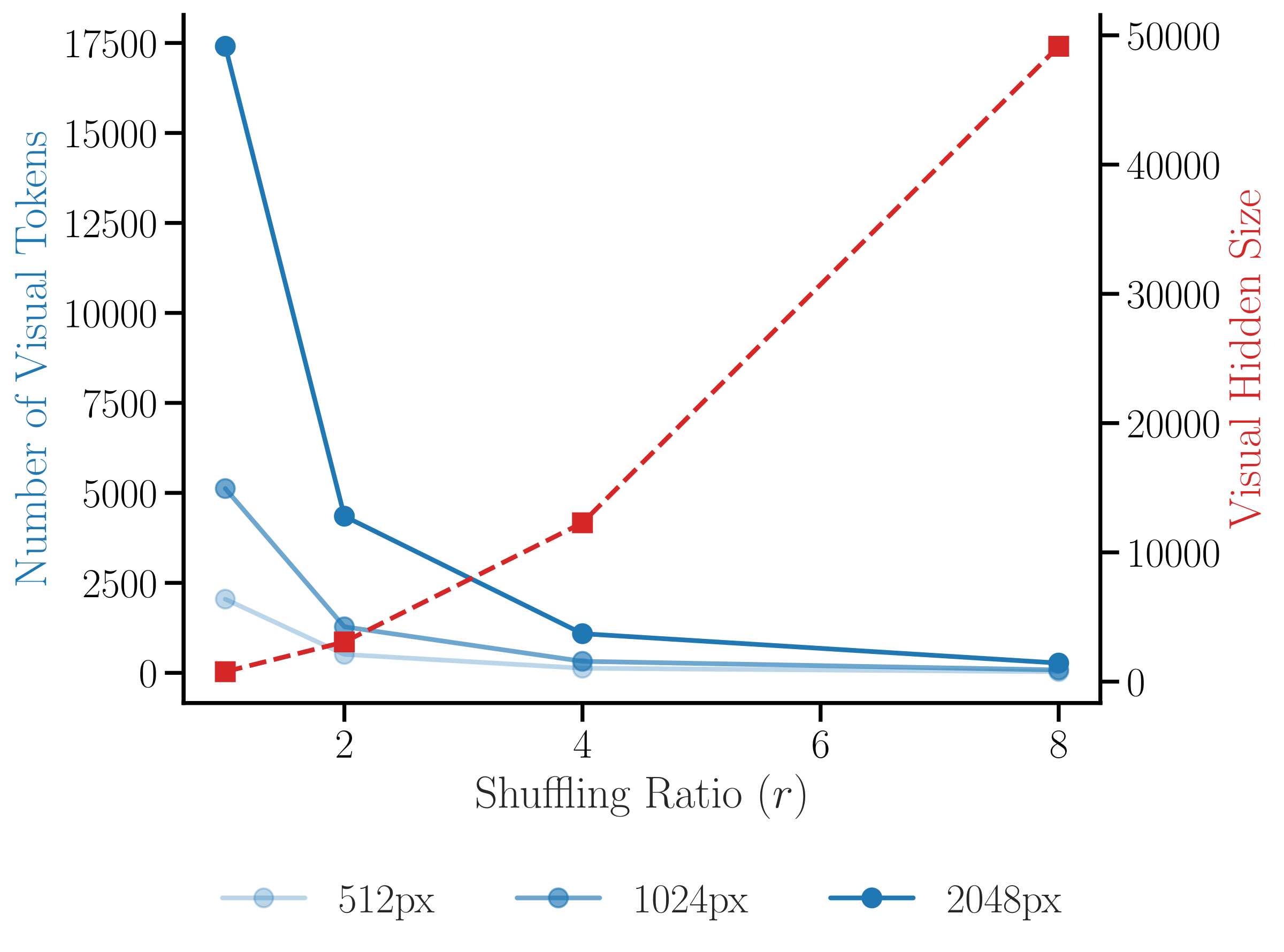
Figure 7 presents the pixel shuffling trade-off. Processing larger images creates more visual tokens, leading to very long sequences (around tokens for a 2048x2048 px image with no pixel shuffling). Pixel shuffling allow to compress these sequence by concatenating the embeddings of spatially close patches. This diminishes the number of tokens for longer visual token embeddings. Table 8 presents the latency to process one image of various resolutions on one L4 GPU and CPU.
| Num. Visual Tokens | CPU Latency (ms) | GPU Latency (ms) | |
| px | |||
| px | |||
| px |
Online Query Encoding Latency
We evaluate the query embedding speed of our model on GPU. We use a single Nvidia H100 with 80GB of VRAM. As for Section 5.4.2, latencies are computed in batch size 1 to simulate online situations, and are averaged over all NanoBEIR queries. Only the text parameters are loaded and run, to minimize memory usage. Parameters are cast to bfloat16 and Flash Attention 2 is used. The resulting speeds are often much faster than those obtained by running inference through each model's reference implementation. Results are shown in Table 9). Interestingly in this setup where memory is not a bottleneck, model depth seems to be a large performance driver, sometimes more the parameter count. We finally evaluate batched GPU throughput. We use batches of size 512 by default and iteratively half it when memory is insufficient. We observe that ModernVBERT based models are extremely fast and can process 5000 queries per second. In the table, the reported figures correspond to the inverted throughput (latency per batch divided by the number of queries per batch). These speed and throughput gains are made possible due to a combination of size, and efficient hardware-informed design as well as the support of flash attention and sequence packing other models of the size often lack .
| Late Interaction | Model Size (B) | CPU Latency (ms) | GPU Latency (ms) | GPU Batching (ms) | |
| 1B Parameters | |||||
| MoCa-3B | 3.75 | ||||
| VLM2Vec | 4.15 | ||||
| GME-Qwen2-7B | 8.29 | ||||
| E5-V | 8.36 | ||||
| ColPali | ✓ | 2.92 | |||
| ColQwen2.5 | ✓ | 3.75 | |||
| Jina-v4 | ✓ | 3.75 | |||
| NemoRetriever-3B | ✓ | 4.40 | |||
| 1B Parameters | |||||
| Jina CLIP | .22 | ||||
| BGE Visualized M3 | .87 | ||||
| SigLIP2-L-512/16 | .88 | ||||
| ColFlor | ✓ | .17 | |||
| BiModernVBERT (ours) | .25 | ||||
| ColModernVBERT (ours) | ✓ | .25 | |||
References
- Hugo Laurençon, Léo Tronchon, Matthieu Cord, Victor Sanh (2024). What matters when building vision-language models?. arXiv. Source ↗
- Hugo Laurençon, Andrés Marafioti, Victor Sanh, Léo Tronchon (2024). Building and better understanding vision-language models: insights and future directions..
- Manuel Faysse, Hugues Sibille, Tony Wu, Bilel Omrani, Gautier Viaud, Céline Hudelot, Pierre Colombo (2025). ColPali: Efficient Document Retrieval with Vision Language Models. International Conference on Learning Representations (ICLR 2025). Source ↗
- Tsung-Yi Lin, Michael Maire, Serge Belongie, Lubomir Bourdev, Ross Girshick, James Hays, Pietro Perona, Deva Ramanan, C. Lawrence Zitnick, Piotr Dollár (2014). Microsoft COCO: Common Objects in Context. arXiv. Source ↗
- Nandan Thakur, Crystina Zhang, Xueguang Ma, Jimmy Lin (2025). Fixing Data That Hurts Performance: Cascading LLMs to Relabel Hard Negatives for Robust Information Retrieval. Source ↗
- Samyam Rajbhandari, Jeff Rasley, Olatunji Ruwase, Yuxiong He (2020). ZeRO: Memory Optimizations Toward Training Trillion Parameter Models. Source ↗
- Tianqi Chen, Bing Xu, Chiyuan Zhang, Carlos Guestrin (2016). Training Deep Nets with Sublinear Memory Cost. Source ↗
- Tri Dao (2023). FlashAttention-2: Faster Attention with Better Parallelism and Work Partitioning. Source ↗
- Haonan Chen, Hong Liu, Yuping Luo, Liang Wang, Nan Yang, Furu Wei, Zhicheng Dou (2025). MoCa: Modality-aware Continual Pre-training Makes Better Bidirectional Multimodal Embeddings. Source ↗
- Xin Zhang, Yanzhao Zhang, Wen Xie, Mingxin Li, Ziqi Dai, Dingkun Long, Pengjun Xie, Meishan Zhang, Wenjie Li, Min Zhang (2025). GME: Improving Universal Multimodal Retrieval by Multimodal LLMs. Source ↗
- Peng Wang, Shuai Bai, Sinan Tan, Shijie Wang, Zhihao Fan, Jinze Bai, Keqin Chen, Xuejing Liu, Jialin Wang, Wenbin Ge, Yang Fan, Kai Dang, Mengfei Du, Xuancheng Ren, Rui Men, Dayiheng Liu, Chang Zhou, Jingren Zhou, Junyang Lin (2024). Qwen2-VL: Enhancing Vision-Language Model's Perception of the World at Any Resolution. Source ↗
- Ziyan Jiang, Rui Meng, Xinyi Yang, Semih Yavuz, Yingbo Zhou, Wenhu Chen (2024). VLM2Vec: Training Vision-Language Models for Massive Multimodal Embedding Tasks. Source ↗
- Marah Abdin, Sam Ade Jacobs, Ammar Ahmad Awan, Jyoti Aneja, Ahmed Awadallah, Hany Awadalla, Nguyen Bach, Amit Bahree, Arash Bakhtiari, Harkirat Behl, Alon Benhaim, Misha Bilenko, Johan Bjorck, Sébastien Bubeck, Martin Cai, Caio César Teodoro Mendes, Weizhu Chen, Vishrav Chaudhary, Parul Chopra, Allie Del Giorno, Gustavo de Rosa, Matthew Dixon, Ronen Eldan, Dan Iter, Amit Garg, Abhishek Goswami, Suriya Gunasekar, Emman Haider, Junheng Hao, Russell J. Hewett, Jamie Huynh, Mojan Javaheripi, Xin Jin, Piero Kauffmann, Nikos Karampatziakis, Dongwoo Kim, Mahoud Khademi, Lev Kurilenko, James R. Lee, Yin Tat Lee, Yuanzhi Li, Chen Liang, Weishung Liu, Eric Lin, Zeqi Lin, Piyush Madan, Arindam Mitra, Hardik Modi, Anh Nguyen, Brandon Norick, Barun Patra, Daniel Perez-Becker, Thomas Portet, Reid Pryzant, Heyang Qin, Marko Radmilac, Corby Rosset, Sambudha Roy, Olatunji Ruwase, Olli Saarikivi, Amin Saied, Adil Salim, Michael Santacroce, Shital Shah, Ning Shang, Hiteshi Sharma, Xia Song, Masahiro Tanaka, Xin Wang, Rachel Ward, Guanhua Wang, Philipp Witte, Michael Wyatt, Can Xu, Jiahang Xu, Sonali Yadav, Fan Yang, Ziyi Yang, Donghan Yu, Chengruidong Zhang, Cyril Zhang, Jianwen Zhang, Li Lyna Zhang, Yi Zhang, Yue Zhang, Yunan Zhang, Xiren Zhou (2024). Phi-3 Technical Report: A Highly Capable Language Model Locally on Your Phone. arXiv. Source ↗
- Ting Jiang, Minghui Song, Zihan Zhang, Haizhen Huang, Weiwei Deng, Feng Sun, Qi Zhang, Deqing Wang, Fuzhen Zhuang (2024). E5-V: Universal Embeddings with Multimodal Large Language Models. Source ↗
- Lucas Beyer, Andreas Steiner, André Susano Pinto, Alexander Kolesnikov, Xiao Wang, Daniel Salz, Maxim Neumann, Ibrahim Alabdulmohsin, Michael Tschannen, Emanuele Bugliarello, Thomas Unterthiner, Daniel Keysers, Skanda Koppula, Fangyu Liu, Adam Grycner, Alexey Gritsenko, Neil Houlsby, Manoj Kumar, Keran Rong, Julian Eisenschlos, Rishabh Kabra, Matthias Bauer, Matko Bošnjak, Xi Chen, Matthias Minderer, Paul Voigtlaender, Ioana Bica, Ivana Balazevic, Joan Puigcerver, Pinelopi Papalampidi, Olivier Henaff, Xi Xiong, Radu Soricut, Jeremiah Harmsen, Xiaohua Zhai (2024). PaliGemma: A versatile 3B VLM for transfer. Source ↗
- Michael Günther, Saba Sturua, Mohammad Kalim Akram, Isabelle Mohr, Andrei Ungureanu, Bo Wang, Sedigheh Eslami, Scott Martens, Maximilian Werk, Nan Wang, Han Xiao (2025). jina-embeddings-v4: Universal Embeddings for Multimodal Multilingual Retrieval. Source ↗
- Mengyao Xu, Gabriel Moreira, Ronay Ak, Radek Osmulski, Yauhen Babakhin, Zhiding Yu, Benedikt Schifferer, Even Oldridge (2025). Llama Nemoretriever Colembed: Top-Performing Text-Image Retrieval Model. Source ↗
- Andreas Koukounas, Georgios Mastrapas, Michael Günther, Bo Wang, Scott Martens, Isabelle Mohr, Saba Sturua, Mohammad Kalim Akram, Joan Fontanals Martínez, Saahil Ognawala, Susana Guzman, Maximilian Werk, Nan Wang, Han Xiao (2024). Jina CLIP: Your CLIP Model Is Also Your Text Retriever. arXiv. Source ↗
- Junjie Zhou, Zheng Liu, Shitao Xiao, Bo Zhao, Yongping Xiong (2024). VISTA: Visualized Text Embedding For Universal Multi-Modal Retrieval. Source ↗
- Jianlv Chen, Shitao Xiao, Peitian Zhang, Kun Luo, Defu Lian, Zheng Liu (2024). BGE M3-Embedding: Multi-Lingual, Multi-Functionality, Multi-Granularity Text Embeddings Through Self-Knowledge Distillation. arXiv. Source ↗
- Michael Tschannen, Alexey Gritsenko, Xiao Wang, Muhammad Ferjad Naeem, Ibrahim Alabdulmohsin, Nikhil Parthasarathy, Talfan Evans, Lucas Beyer, Ye Xia, Basil Mustafa, Olivier Hénaff, Jeremiah Harmsen, Andreas Steiner, Xiaohua Zhai (2025). SigLIP 2: Multilingual Vision-Language Encoders with Improved Semantic Understanding, Localization, and Dense Features. Source ↗
- Ahmed Masry, Enamul Hoque (2024). ColFlor: Towards BERT-Size Vision-Language Document Retrieval Models.
- Chenghao Xiao, Isaac Chung, Imene Kerboua, Jamie Stirling, Xin Zhang, Márton Kardos, Roman Solomatin, Noura Al Moubayed, Kenneth Enevoldsen, Niklas Muennighoff (2025). MIEB: Massive Image Embedding Benchmark. Source ↗
- Omar Khattab, Matei Zaharia (2020). ColBERT: Efficient and Effective Passage Search via Contextualized Late Interaction over BERT. Proceedings of the 43rd International ACM SIGIR Conference on Research and Development in Information Retrieval. Source ↗
- Antoine Chaffin (2025). GTE-ModernColBERT. Source ↗
- Yi-Lin Sung, Linjie Li, Kevin Lin, Zhe Gan, Mohit Bansal, Lijuan Wang (2023). An Empirical Study of Multimodal Model Merging. Source ↗
- Sebastian Dziadzio, Vishaal Udandarao, Karsten Roth, Ameya Prabhu, Zeynep Akata, Samuel Albanie, Matthias Bethge (2024). How to Merge Your Multimodal Models Over Time?. Source ↗
- Mingxin Li, Zhijie Nie, Yanzhao Zhang, Dingkun Long, Richong Zhang, Pengjun Xie (2024). Improving General Text Embedding Model: Tackling Task Conflict and Data Imbalance through Model Merging. Source ↗
- Yanzhao Zhang, Mingxin Li, Dingkun Long, Xin Zhang, Huan Lin, Baosong Yang, Pengjun Xie, An Yang, Dayiheng Liu, Junyang Lin, Fei Huang, Jingren Zhou (2025). Qwen3 Embedding: Advancing Text Embedding and Reranking Through Foundation Models. Source ↗
- Gabriel Ilharco, Mitchell Wortsman, Samir Yitzhak Gadre, Shuran Song, Hannaneh Hajishirzi, Simon Kornblith, Ali Farhadi, Ludwig Schmidt (2022). Patching open-vocabulary models by interpolating weights. Source ↗
- Ken Shoemake (1985). Animating rotation with quaternion curves. Association for Computing Machinery. Source ↗
- Benjamin Warner, Antoine Chaffin, Benjamin Clavié, Orion Weller, Oskar Hallström, Said Taghadouini, Alexis Gallagher, Raja Biswas, Faisal Ladhak, Tom Aarsen, Nathan Cooper, Griffin Adams, Jeremy Howard, Iacopo Poli (2024). Smarter, Better, Faster, Longer: A Modern Bidirectional Encoder for Fast, Memory Efficient, and Long Context Finetuning and Inference. Source ↗