Opening
Chapter 2
A Brief History of Information Retrieval
While this thesis does not aim to provide an extensive overview of past or modern Information Retrieval techniques, the following section will provide a rapid overview of the field in order to contextualize the contributions of this thesis.
Further finely scoped related work is also introduced in each individual chapter.
Early Pre-Digital Cataloging
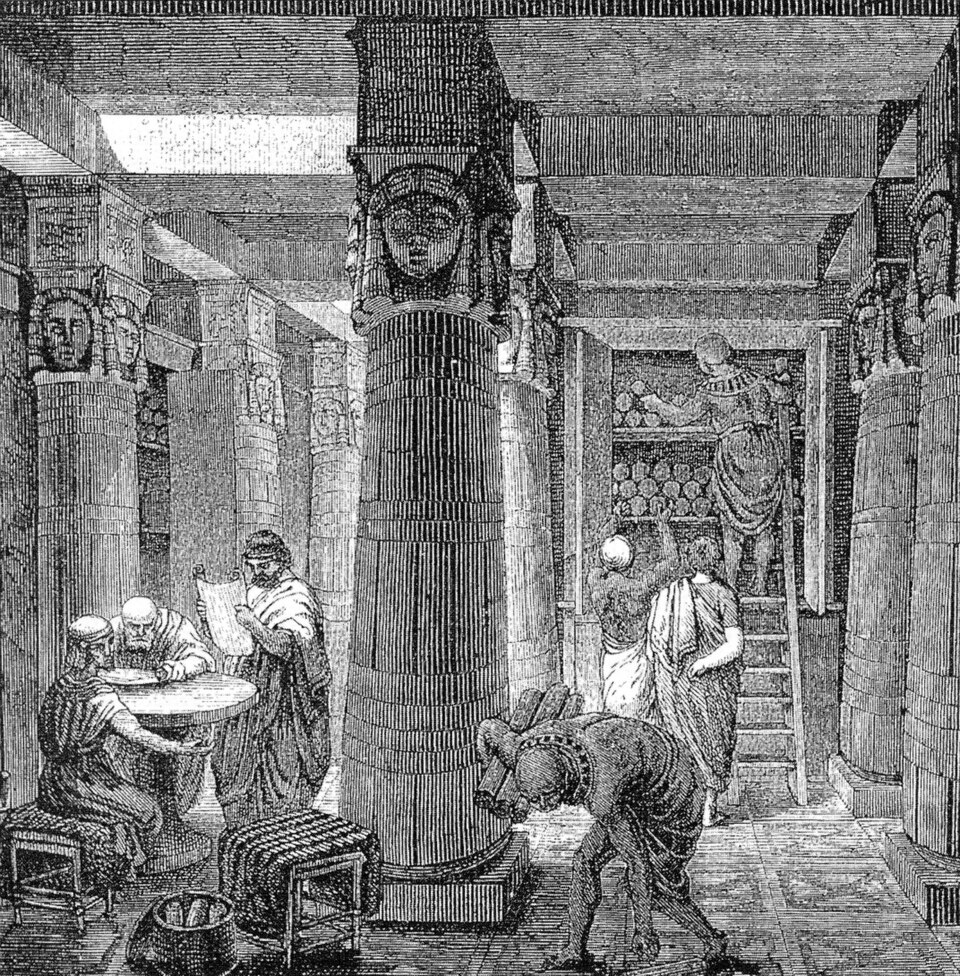
Long before computers, humans developed methods to organize and retrieve information. One of the earliest examples is the Pinakes of Callimachus around the 3rd century BCE, often considered the first library catalog in the Western world. The Pinakes is said to have systematically cataloged the authors and works held in the Library of Alexandria, organizing texts by subject and arranging authors alphabetically — an early bibliographic method that helped lay the foundations for later library catalogs.
Through the centuries, librarians and scholars continued to develop catalogs and classification systems, from medieval manuscript indexes to Melvil Dewey’s Decimal Classification in 1876. These pre-digital innovations addressed the same core challenge as modern IR systems: how to store, organize, and find relevant information efficiently. In 1945, Vannevar Bush articulated a technological vision for the future of information retrieval in As We May Think . He describes the inadequacy of indexing-based systems for navigating the deluge of information:
Bush's vision was that new technology would enable moving away from this system. He proposes the Memex, a hypothetical electromechanical desk that could instantly retrieve microfilmed documents via associative links.
Founding of Information Retrieval (1950s–1960s)
Information Retrieval as a distinct field took shape in the 1950s and 1960s, alongside the advent of digital computers. In 1950, Calvin Mooers coined the term "information retrieval" , heralding the idea of using machines to search document collections. Early experiments followed quickly: in 1951, a master’s thesis at MIT by Philip Bagley demonstrated one of the first computerized document retrieval experiments. Pioneers like Hans Peter Luhn at IBM began applying computers to automate indexing; for example, Luhn developed methods for auto-encoding documents and keyword-in-context indexing. By 1959 he published the influential paper Auto-Encoding of Documents for Information Retrieval Systems , showing how computers could encode text and allow electronic searching of content. This period also saw growing support for IR research as the U.S. government recognized an information explosion funding projects on mechanized literature searching and the creation of citation indexes.
The Cranfield paradigm. A key milestone was the Cranfield experiments , led by Pete Cleverdon in the early 1960s. The Cranfield studies introduced a rigorous experimental methodology for IR: assembling a test collection of documents, queries, and relevance judgments, and evaluating retrieval performance using metrics like precision and recall. This methodology became a cornerstone of IR research, establishing a scientific approach to evaluate how “relevant” the results returned by an IR system are, laying the foundation for future benchmarks.
Early retrieval models. During the same era, Gerard Salton formed the first major IR research group (at Harvard, later Cornell). Researchers began formulating the first theoretical models of IR. In 1960, Maron and Kuhns proposed a probabilistic indexing model , foreshadowing later probabilistic retrieval approaches. Salton and others started developing what became the vector space model: by the late 1960s, Salton’s team had created the SMART system, representing documents and queries as vectors in a term-weighted space. In 1968 Salton published Automatic Information Organization and Retrieval , and by 1975 he fully articulated the vector space framework and term-weighting schemes . Another 1960s contribution came from Karen Spärck Jones, who introduced the concept of inverse document frequency (IDF) (Spärck Jones 1972) to statistically downweight common terms and boost rare, informative terms – a principle that soon became central to ranking algorithms.
The Statistical Revolution in IR (1970s–1990s)
Term weighting and probabilistic ranking. With the fundamentals laid, subsequent decades saw rapid improvement in statistical text retrieval methods. The 1970s refined the vector space and probabilistic models. Term frequency–inverse document frequency (TF–IDF) weighting became a standard technique: terms are scored higher if they appear frequently in a document (term frequency) but are rare across the collection (high IDF). On the probabilistic side, Stephen Robertson and colleagues extended early ideas into the Probabilistic Relevance Framework in the 1970s and 1980s, leading to the development of ranking functions that estimate the probability a document is relevant to a query. These efforts culminated in the 1990s with Okapi BM25 , developed in the Okapi/TREC line of work from the Robertson–Spärck Jones probabilistic framework and Robertson–Walker 2-Poisson approximations. By incorporating TF–IDF-like features into a probabilistic model, BM25 became one of the dominant ranking algorithms in search and remains widely used as a strong baseline in modern information retrieval systems.
Online search systems. Alongside algorithm advances, IR systems grew in scale and importance. The first online search systems appeared in the early 1970s as databases of bibliographic records: for example, MEDLINE (1971) provided biomedical literature search, and DIALOG offered commercial online search over multiple databases. These systems predated personal computers—users accessed them via terminals—but they demonstrated that searching thousands of documents via text queries was feasible and valuable. In 1978, the IR community established its premier conference, ACM SIGIR , reflecting the field's maturation.
By the 1980s, personal computing and CD-ROMs enabled standalone IR systems (like library catalog CDs), and researchers explored new ideas such as relevance feedback through the Rocchio algorithm (which allowed a system to adjust a query based on documents a user marked relevant) and clustering through the "cluster hypothesis" (relevant documents tend to cluster together). The inverted index (storing, for each term, a list of documents containing it) became a core data structure, enabling fast keyword lookup even as collections grew to tens of thousands of documents. This era also saw experiments with user interfaces and visualization (e.g. plotting document similarity or using hypertext systems).
Standardizing evaluation. Evaluation at scale took a leap in 1992 with the start of the Text Retrieval Conference (TREC) . TREC built large standard test collections and yearly competitions for state-of-the-art retrieval methods. TREC not only pushed research towards scalable methods but also fostered the development of specialized tasks. Many techniques that became important, such as query expansion and relevance feedback, were evaluated and refined through TREC workshops.
Enter The Web (1990s–2010s)
Search at web scale. Web search emerged in the mid-1990s as a new frontier that dramatically expanded IR's scale and impact. It also marked an important step toward Vannevar Bush's vision of associative information access. In Bush's Memex, users would create and follow trails through related documents; on the Web, hyperlinks made such associative connections part of the infrastructure of global information access. Association however is not the same as retrieval. Links helped users navigate once useful pages were found, yet they did not by themselves determine which pages were authoritative, relevant, or worth visiting.
Early web search systems and directories—for example, Yahoo!'s human-curated directory in 1994 and AltaVista in 1995—helped users navigate the growing World Wide Web, but human-maintained directories were difficult to scale and keyword-based engines often returned many low-quality matches at web scale .
Link-based ranking. A major breakthrough came from the Stanford/Google work of the late 1990s, especially PageRank , which treated the web as a graph and used hyperlinks as an additional ranking signal: a page linked from many other pages, especially pages that were themselves important, received a higher importance score. By combining link analysis with content relevance, anchor text, proximity, and other web-specific signals, Google produced more useful rankings than many earlier content-only systems. This represented a graph-based retrieval innovation, leveraging network topology in a way analogous to citation analysis in scholarly literature.
Learned and semantic ranking. In the 2000s, machine learning techniques became increasingly central to IR. Learning-to-rank algorithms learned how to combine many ranking features—such as lexical matching scores, anchor-text evidence, document features, and user-behavior-derived signals—into ranking functions. Microsoft Research developed RankNet, LambdaRank, and LambdaMART in the mid-2000s, with LambdaMART combining LambdaRank-style optimization with boosted decision trees. Commercial search engines increasingly incorporated machine-learned ranking methods, although the exact algorithms and deployment timelines were often proprietary.
Researchers also showed that clickthrough logs and query reformulations could provide useful implicit feedback for ranking .
Another 2000s-and-2010s trend was the use of semantic information and knowledge bases. For instance, Bing publicly described its Satori knowledge system in 2013 as modeling entities—people, places, and things—and relationships among them. Google also moved in this direction through systems such as the Knowledge Graph and, in 2013, Hummingbird , a major improvement to its ranking systems associated with better handling of longer and more conversational queries.
The Deep Learning Era of IR (2010s–2020s)
The 2010s shifted information retrieval from purely lexical matching toward neural semantic matching. Early neural IR systems such as DSSM mapped queries and documents into learned vector spaces, allowing systems to match texts that used different words but expressed related meanings. This was the beginning of dense retrieval: instead of representing a document only by the terms it contains, the system learns a continuous embedding that captures semantic similarity.
The BERT revolution. The transformer era accelerated this shift. BERT showed that large pretrained language models could produce rich contextual representations of text, and by 2019 Google had publicly announced the use of BERT in Search to better handle longer, more conversational queries. In academic IR, BERT-style cross-encoders became especially effective as rerankers: a first-stage retriever such as BM25 or a dense retriever retrieves a candidate set, and a neural model then scores each query–document pair more precisely.
Bi-encoders. At the same time, researchers developed neural retrievers that could operate efficiently at first stage. The key idea behind bi-encoders is to give up full query–document interaction at retrieval time: the query and each document are encoded separately, each text is compressed into a single vector, and retrieval becomes efficient nearest-neighbor search in embedding space . Sentence-BERT made this recipe practical for BERT-style models by pooling contextualized token embeddings into sentence vectors that can be compared directly with cosine similarity. Its training objectives then teach the pooled vectors to behave geometrically: paraphrases and semantically related sentences should be close, while unrelated sentences should be far apart. DPR adapted this principle to passage retrieval, using contrastive training so that a question vector is closer to its gold passage than to in-batch or mined negatives. These models helped establish the modern dense-retrieval template: encode documents once, index their vectors, and retrieve efficiently at query time.
By the early 2020s, the dominant neural IR systems were often multi-stage: one or several fast lexical, sparse, or dense retriever produces candidates; a stronger neural reranker refines them. Systems often combined lexical and semantic signals rather than replacing one with the other to capture a variety of signals .
The Modern Stack: Hybrid, Contextual, and Agentic Retrieval
While the retrieve–rerank paradigm remains widely used in production systems, recent years have seen substantial improvements to every stage of the retrieval pipeline and the emergence of novel ideas.
Modern general-purpose embeddings. General-purpose embedding models (bi-encoders) remain one of the central model families in modern IR. Their goal is to map queries and documents into a shared representation space that supports a wide range of retrieval and semantic-matching tasks. Progress in this area has often been driven by benchmark optimization, especially on IR benchmarks such as BEIR and broader embedding benchmarks such as MTEB .
Recent gains in embedding quality have come from several directions. One is improved training recipes and data construction. GTE trains unified text embeddings through multi-stage contrastive learning over diverse datasets. NV-Retriever emphasizes the importance of hard-negative mining, especially positive-aware methods that reduce the risk of treating genuinely relevant passages as negatives during contrastive training. ReasonIR trains retrievers on synthetic queries and hard negatives designed to teach relevance as usefulness for inference, rather than merely direct lexical overlap or surface-level semantic similarity.
A second major direction is the repurposing of large language models as embedding models. E5-Mistral shows that strong embedding models can be built by adapting LLMs and training them on large synthetic, instruction-style datasets. LLM2Vec converts decoder-only causal LLMs into bidirectional text encoders using bidirectional attention, masked next-token prediction, and contrastive learning. NV-Embed further introduces practical techniques such as latent-attention pooling, removal of the causal mask during contrastive training, and two-stage instruction tuning. More recent work also asks whether the bi-encoder paradigm itself can become more controllable. Promptriever shows that dense retrievers can be prompted in natural language, while preserving the efficiency advantages of independently encoded queries and documents. Instead of treating the query as a fixed semantic object, Promptriever conditions retrieval on per-instance instructions that redefine what should count as relevant.
Expressive Matching Functions. Single-vector representation must compress all potentially relevant aspects of a document into one point in embedding space, and cosine similarity can express only a limited class of query–document relationships. The LIMIT benchmark shows theoretically and empirically that single-vector embedding models cannot represent all possible top- relevance patterns unless the embedding dimension is sufficiently large; in practice, even strong embedding models fail on LIMIT, while lexical, multi-vector, and reranking approaches that leverage more expressive matching functions are less affected.
Cross-encoders occupy the high-expressiveness end of this spectrum. Rather than encoding the query and document independently, they concatenate the query and candidate document and process them jointly with transformer self-attention. This allows every query token to attend to every document token, making the transformer itself a rich matching function. The cost is that documents cannot be precomputed as standalone vectors: each query–document pair must be scored separately, so these approaches are often used as a second reranking stage after first filtering with faster models.
LLM rerankers can be viewed as a compute-scaled version of the cross-encoder idea. Instead of using a relatively small supervised transformer reranker, an instruction-tuned LLM can be prompted to judge or rank candidate documents for a query. RankGPT showed that ChatGPT and GPT-4 can act as strong zero-shot rerankers, including in listwise settings where the model compares several candidates and outputs an ordering. This setup leverages both the expressive self-attention mechanism of large transformers and the broader linguistic, reasoning, and instruction-following priors acquired during LLM training. Recent work further explores whether reranking can benefit from explicit test-time computation. Rank1 trains rerankers to produce reasoning traces before judging relevance, distilling traces from a stronger reasoning model into smaller reranking models.
Late-interaction models provide one way to increase expressiveness without moving all the way to full cross-encoder reranking. Instead of representing each query or document with a single vector, models such as ColBERT represent them as sets of contextualized token vectors. Documents can still be indexed in advance, but scoring is performed through token-level interactions, typically using a MaxSim operator that matches each query token against its best document-token counterpart.
Hypencoders propose another way to improve matching expressivity: the query encoder produces a small neural network that scores document representations, enabling query-specific relevance functions. Like late interaction, Hypencoder can be seen as an attempt to move beyond fixed cosine similarity while preserving some of the efficiency advantages of retrieval-time indexing.
Generative information retrieval (GenIR) departs more radically from standard matching-based retrieval: instead of comparing a query representation against indexed document representations, a generative model directly produces relevant document identifiers given a query, typically by having assimilated the corpus content in parametric memory . While scaling GenIR to very large corpora remains difficult, it is an interesting concept because it exploits associative recall in a way standard retrieval models cannot.
Learned sparse retrieval. Sparse retrieval has also returned in neural form. Learned sparse models retain the efficiency and interpretability advantages of inverted indexes while learning term expansion and weighting from data. SPLADE is a representative example: it learns sparse lexical representations using explicit sparsity regularization and log-saturated term weights, making it suitable for first-stage retrieval with standard inverted-index infrastructure.
Recent work pushes sparse retrieval beyond surface vocabulary terms. Sparse-autoencoder-based retrieval models such as SPLARE learn sparse latent embeddings from LLM representations, aiming for more semantic and multilingual sparse features. The Latent Terms line of work similarly shows that dense retrievers can contain extractable sparse, BM25-ready latent features, suggesting that dense and sparse retrieval are not as separate as they first appear.
Context-aware document representations. Many retrieval-augmented generation systems split documents into chunks before embedding them, but this can remove the broader context needed to interpret each passage. Late Chunking addresses this by first encoding a longer text with a long-context embedding model and only then pooling token representations into chunk embeddings. As a result, each chunk vector can retain information from the surrounding document. In this line of thought, Contextual Document Embeddings leverage priors on the corpus distribution when producing document embeddings to better express document specificity.
Modern Retrieval-Augmented Generation. Retrieval-Augmented Generation (RAG) (Lewis et al. 2020) reframes retrieval as a conditioning mechanism for language generation. Instead of returning only a ranked list of documents, a retriever selects a small set of passages, and a language model generates an answer conditioned on this external context. In practice, this changes the role of ranking: the goal is no longer merely to order documents for a human reader, but to select evidence that will fit within the model's context window and support a faithful synthesis. RAG in its current form has become one of the main industrial use cases of modern generative AI.
Agentic Search. Beyond generating from a fixed set of retrieved passages, modern LLMs can participate directly in the search process. WebGPT and ReAct showed that language models can browse, call tools, inspect retrieved evidence, and decide which action to take next. This turns retrieval into an iterative loop: the model can decompose a task, issue searches, revise its query, and update its information need as evidence accumulates. IRCoT makes this loop explicit for multi-hop question answering by interleaving retrieval with chain-of-thought reasoning, while Self-RAG trains a model to decide when to retrieve and to critique both retrieved evidence and its own generations.
A related line of work questions the retrieval interface itself. Direct Corpus Interaction (DCI) argues that exposing a corpus only through a fixed top- retrieval API can be too restrictive for agents. Instead, an agent can interact directly with the raw corpus using general-purpose tools such as grep, file reads, shell commands, and lightweight scripts.
These new usage patterns change what retrievers should optimize for. When the retriever serves an agent rather than a human, the input is no longer just a standalone search query: it may include intermediate reasoning, subgoals, failed attempts, and partially discovered evidence. AgentIR formalizes this setting by treating deep-research agents as retrieval users. Instead of embedding only the final query, it jointly embeds the agent's reasoning trace and query, allowing retrieval to reflect the agent's evolving intent.
Despite all this progress, the core objective remains similar: finding relevant information hidden in the sum of human knowledge.
References
- Kyle Conrau-Lewis (2018). Medieval Indices: Unlikely Leisurely Reading. Source ↗
- Melvil Dewey (1876). A Classification and Subject Index for Cataloguing and Arranging the Books and Pamphlets of a Library.
- Vannevar Bush (1945). As We May Think.
- Calvin N. Mooers (1950). The Theory of Digital Handling of Non-Numerical Information and Its Implications to Machine Economics.
- Philip Rutherford Bagley (1951). Electronic Digital Machines for High-Speed Information Searching.
- H. P. Luhn (1959). Auto-Encoding of Documents for Information Retrieval Systems. Modern Trends in Documentation: Proceedings of a Symposium Held at the University of Southern California, April 1958.
- Cyril W. Cleverdon (1967). The Cranfield Tests on Index Language Devices. Source ↗
- M. E. Maron, J. L. Kuhns (1960). On Relevance, Probabilistic Indexing and Information Retrieval. Source ↗
- Gerard Salton (1968). Automatic Information Organization and Retrieval. McGraw-Hill.
- Gerard Salton, Anita Wong, Chung-Shu Yang (1975). A Vector Space Model for Automatic Indexing. Source ↗
- Karen Spärck Jones (1972). A Statistical Interpretation of Term Specificity and Its Application in Retrieval. Source ↗
- Stephen E. Robertson, Karen Sparck Jones (1976). Relevance Weighting of Search Terms. Source ↗
- Stephen E. Robertson (1977). The Probability Ranking Principle in IR. Source ↗
- Stephen Robertson, Hugo Zaragoza (2009). The Probabilistic Relevance Framework: BM25 and Beyond. Source ↗
- Stephen E. Robertson, Steve Walker (1994). Some Simple Effective Approximations to the 2-Poisson Model for Probabilistic Weighted Retrieval. Proceedings of the 17th Annual International ACM SIGIR Conference on Research and Development in Information Retrieval. Source ↗
- Stephen E. Robertson, Steve Walker, Susan Jones, Micheline Hancock-Beaulieu, Mike Gatford (1994). Okapi at TREC-3. Proceedings of The Third Text REtrieval Conference, TREC 1994, Gaithersburg, Maryland, USA, November 2-4, 1994. Source ↗
- Christopher D. Manning, Prabhakar Raghavan, Hinrich Schütze (2008). Introduction to Information Retrieval. Cambridge University Press. Source ↗
- National Library of Medicine (2024). MEDLINE History. Source ↗
- Engineering, Technology History Wiki (2019). Milestones: DIALOG Online Search System, 1966. Source ↗
- Robert T. Dattola (1978). ACM-SIGIR Conference on Information Storage and Retrieval. ACM.
- J. J. Rocchio (1971). Relevance Feedback in Information Retrieval. The SMART Retrieval System: Experiments in Automatic Document Processing.
- N. Jardine, C. J. van Rijsbergen (1971). The Use of Hierarchic Clustering in Information Retrieval. Source ↗
- C. J. van Rijsbergen (1979). Information Retrieval. Butterworths.
- Donna Harman (1993). Overview of the First Text REtrieval Conference. Proceedings of the 16th Annual International ACM SIGIR Conference on Research and Development in Information Retrieval.
- Sergey Brin, Lawrence Page (1998). The Anatomy of a Large-Scale Hypertextual Web Search Engine. Source ↗
- Lawrence Page, Sergey Brin, Rajeev Motwani, Terry Winograd (1998). The PageRank Citation Ranking: Bringing Order to the Web.
- Christopher J. C. Burges, Tal Shaked, Erin Renshaw, Ari Lazier, Matt Deeds, Nicole Hamilton, Gregory N. Hullender (2005). Learning to Rank Using Gradient Descent. Proceedings of the 22nd International Conference on Machine Learning. Source ↗
- Christopher J. C. Burges, Robert Ragno, Quoc Viet Le (2006). Learning to Rank with Nonsmooth Cost Functions. Advances in Neural Information Processing Systems 19.
- Chris J. C. Burges (2010). From RankNet to LambdaRank to LambdaMART: An Overview.
- Thorsten Joachims (2002). Optimizing Search Engines Using Clickthrough Data. Proceedings of the Eighth ACM SIGKDD International Conference on Knowledge Discovery and Data Mining. Source ↗
- Thorsten Joachims, Laura A. Granka, Bing Pan, Helene Hembrooke, Geri Gay (2005). Accurately Interpreting Clickthrough Data as Implicit Feedback. Proceedings of the 28th Annual International ACM SIGIR Conference on Research and Development in Information Retrieval. Source ↗
- Filip Radlinski, Thorsten Joachims (2005). Query Chains: Learning to Rank from Implicit Feedback. Proceedings of the 11th ACM SIGKDD International Conference on Knowledge Discovery and Data Mining. Source ↗
- Bing Search Blog (2013). Understand Your World with Bing. Source ↗
- Google Search Central (2025). A Guide to Google Search Ranking Systems. Source ↗
- Po-Sen Huang, Xiaodong He, Jianfeng Gao, Li Deng, Alex Acero, Larry P. Heck (2013). Learning Deep Structured Semantic Models for Web Search using Clickthrough Data. Proceedings of the 22nd ACM International Conference on Information and Knowledge Management. Source ↗
- Jacob Devlin, Ming-Wei Chang, Kenton Lee, Kristina Toutanova (2019). BERT: Pre-training of Deep Bidirectional Transformers for Language Understanding. Proceedings of the 2019 Conference of the North American Chapter of the Association for Computational Linguistics: Human Language Technologies, Volume 1 (Long and Short Papers). Source ↗
- Pandu Nayak (2019). Understanding searches better than ever before. Source ↗
- Rodrigo Nogueira, Kyunghyun Cho (2019). Passage Re-ranking with BERT. arXiv. Source ↗
- Andrew Yates, Rodrigo Nogueira, Jimmy Lin (2021). Pretrained Transformers for Text Ranking: BERT and Beyond. Proceedings of the 2021 Conference of the North American Chapter of the Association for Computational Linguistics: Human Language Technologies: Tutorials. Source ↗
- Jeff Johnson, Matthijs Douze, Hervé Jégou (2017). Billion-scale Similarity Search with GPUs. Source ↗
- Nils Reimers, Iryna Gurevych (2019). Sentence-BERT: Sentence Embeddings using Siamese BERT-Networks. Proceedings of the 2019 Conference on Empirical Methods in Natural Language Processing and the 9th International Joint Conference on Natural Language Processing (EMNLP-IJCNLP). Source ↗
- Vladimir Karpukhin, Barlas Oguz, Sewon Min, Patrick Lewis, Ledell Wu, Sergey Edunov, Danqi Chen, Wen-tau Yih (2020). Dense Passage Retrieval for Open-Domain Question Answering. Proceedings of the 2020 Conference on Empirical Methods in Natural Language Processing (EMNLP). Source ↗
- Nandan Thakur, Nils Reimers, Andreas Rücklé, Abhishek Srivastava, Iryna Gurevych (2021). BEIR: A Heterogenous Benchmark for Zero-shot Evaluation of Information Retrieval Models. arXiv. Source ↗
- Niklas Muennighoff, Nouamane Tazi, Loic Magne, Nils Reimers (2022). MTEB: Massive Text Embedding Benchmark. arXiv. Source ↗
- John Morris, Volodymyr Kuleshov, Vitaly Shmatikov, Alexander Rush (2023). Text Embeddings Reveal (Almost) As Much As Text. Proceedings of the 2023 Conference on Empirical Methods in Natural Language Processing. Source ↗
- Zehan Li, Xin Zhang, Yanzhao Zhang, Dingkun Long, Pengjun Xie, Meishan Zhang (2023). Towards General Text Embeddings with Multi-stage Contrastive Learning. Source ↗
- Gabriel de Souza P. Moreira, Radek Osmulski, Mengyao Xu, Ronay Ak, Benedikt Schifferer, Even Oldridge (2024). NV-Retriever: Improving Text Embedding Models with Effective Hard-Negative Mining. Source ↗
- Rulin Shao, Rui Qiao, Varsha Kishore, Niklas Muennighoff, Xi Victoria Lin, Daniela Rus, Bryan Kian Hsiang Low, Sewon Min, Wen-tau Yih, Pang Wei Koh, Luke Zettlemoyer (2025). ReasonIR: Training Retrievers for Reasoning Tasks. Source ↗
- Liang Wang, Nan Yang, Xiaolong Huang, Linjun Yang, Rangan Majumder, Furu Wei (2024). Improving Text Embeddings with Large Language Models. Source ↗
- Parishad BehnamGhader, Vaibhav Adlakha, Marius Mosbach, Dzmitry Bahdanau, Nicolas Chapados, Siva Reddy (2024). LLM2Vec: Large Language Models Are Secretly Powerful Text Encoders. arXiv. Source ↗
- Chankyu Lee, Rajarshi Roy, Mengyao Xu, Jonathan Raiman, Mohammad Shoeybi, Bryan Catanzaro, Wei Ping (2024). NV-Embed: Improved Techniques for Training LLMs as Generalist Embedding Models. Source ↗
- Orion Weller, Benjamin Van Durme, Dawn Lawrie, Ashwin Paranjape, Yuhao Zhang, Jack Hessel (2025). Promptriever: Instruction-Trained Retrievers Can Be Prompted Like Language Models. International Conference on Learning Representations. Source ↗
- Orion Weller, Michael Boratko, Iftekhar Naim, Jinhyuk Lee (2026). On the Theoretical Limitations of Embedding-Based Retrieval. International Conference on Learning Representations. Source ↗
- Weiwei Sun, Lingyong Yan, Xinyu Ma, Shuaiqiang Wang, Pengjie Ren, Zhumin Chen, Dawei Yin, Zhaochun Ren (2023). Is ChatGPT Good at Search? Investigating Large Language Models as Re-Ranking Agents. Proceedings of the 2023 Conference on Empirical Methods in Natural Language Processing. Source ↗
- Orion Weller, Kathryn Ricci, Eugene Yang, Andrew Yates, Dawn Lawrie, Benjamin Van Durme (2025). Rank1: Test-Time Compute for Reranking in Information Retrieval. Conference on Language Modeling. Source ↗
- Omar Khattab, Matei Zaharia (2020). ColBERT: Efficient and Effective Passage Search via Contextualized Late Interaction over BERT. Proceedings of the 43rd International ACM SIGIR Conference on Research and Development in Information Retrieval. Source ↗
- Julian Killingback, Hansi Zeng, Hamed Zamani (2025). Hypencoder: Hypernetworks for Information Retrieval. Source ↗
- Yi Tay, Vinh Q. Tran, Mostafa Dehghani, Jianmo Ni, Dara Bahri, Harsh Mehta, Zhen Qin, Kai Hui, Zhe Zhao, Jai Gupta, Tal Schuster, William W. Cohen, Donald Metzler (2022). Transformer Memory as a Differentiable Search Index. Source ↗
- Xiaoxi Li, Jiajie Jin, Yujia Zhou, Yuyao Zhang, Peitian Zhang, Yutao Zhu, Zhicheng Dou (2024). From Matching to Generation: A Survey on Generative Information Retrieval. Source ↗
- Thibault Formal, Benjamin Piwowarski, Stéphane Clinchant (2021). SPLADE: Sparse Lexical and Expansion Model for First Stage Ranking. Proceedings of the 44th International ACM SIGIR Conference on Research and Development in Information Retrieval. Source ↗
- Thibault Formal, Maxime Louis, Hervé Dejean, Stéphane Clinchant (2026). Learning Retrieval Models with Sparse Autoencoders. Source ↗
- Benjamin Clavié, Sean Lee, Aamir Shakir, Makoto P. Kato (2026). Latent Terms: Dense Retrievers Contain Trivially Extractable BM25-ready Zipfian Vocabularies. Source ↗
- Michael Günther, Isabelle Mohr, Daniel James Williams, Bo Wang, Han Xiao (2024). Late Chunking: Contextual Chunk Embeddings Using Long-Context Embedding Models. Source ↗
- John X. Morris, Alexander M. Rush (2024). Contextual Document Embeddings. Source ↗
- Patrick Lewis, Ethan Perez, Aleksandra Piktus, Fabio Petroni, Vladimir Karpukhin, Naman Goyal, Heinrich Küttler, Mike Lewis, Wen-tau Yih, Tim Rocktäschel, Sebastian Riedel, Douwe Kiela (2020). Retrieval-Augmented Generation for Knowledge-Intensive NLP Tasks. arXiv. Source ↗
- Reiichiro Nakano, Jacob Hilton, Suchir Balaji, Jeff Wu, Long Ouyang, Christina Kim, Christopher Hesse, Shantanu Jain, Vineet Kosaraju, William Saunders, others (2021). WebGPT: Browser-assisted Question-Answering with Human Feedback. Source ↗
- Shunyu Yao, Jeffrey Zhao, Dian Yu, Nan Du, Izhak Shafran, Karthik Narasimhan, Yuan Cao (2023). ReAct: Synergizing Reasoning and Acting in Language Models. International Conference on Learning Representations.
- Harsh Trivedi, Niranjan Balasubramanian, Tushar Khot, Ashish Sabharwal (2023). Interleaving Retrieval with Chain-of-Thought Reasoning for Knowledge-Intensive Multi-Step Questions. Proceedings of the 61st Annual Meeting of the Association for Computational Linguistics. Source ↗
- Akari Asai, Zeqiu Wu, Yizhong Wang, Avirup Sil, Hannaneh Hajishirzi (2024). Self-RAG: Learning to Retrieve, Generate, and Critique through Self-Reflection. International Conference on Learning Representations.
- Zhuofeng Li, Haoxiang Zhang, Cong Wei, Pan Lu, Ping Nie, Yi Lu, Yuyang Bai, Shangbin Feng, Hangxiao Zhu, Ming Zhong, Yuyu Zhang, Jianwen Xie, Yejin Choi, James Zou, Jiawei Han, Wenhu Chen, Jimmy Lin, Dongfu Jiang, Yu Zhang (2026). Beyond Semantic Similarity: Rethinking Retrieval for Agentic Search via Direct Corpus Interaction. Source ↗
- Zijian Chen, Xueguang Ma, Shengyao Zhuang, Jimmy Lin, Akari Asai, Victor Zhong (2026). AgentIR: Reasoning-Aware Retrieval for Deep Research Agents. Source ↗